
So, you’ve inherited a statement. Not just a house, but a pile of history with good bones and possibly dodgy wiring. Before you swing the sledgehammer in a fit of HGTV-inspired fervor, stop.
Restoring a classic villa isn’t a demolition derby. It’s more like tuning a vintage Ferrari. You wouldn’t swap the original engine for a lawnmower motor, would you? (Some previous owners, sadly, might have.) This is your pre-game pep talk.

The core challenge is a beautiful tension. It’s about balancing the inherent qualities that give the place its soul with the modern improvements required for contemporary living. Think of it as a forensic audit for character—distinguishing authentic architectural heritage from elements that are simply obsolete. For a structured approach to navigating this process, see our villa renovation and restoration guide, which outlines how to modernize without erasing identity.
This process of architectural preservation respects the original architect’s symphony while composing a new movement for how you actually live. It begins with understanding every detail, from the foundation to the timeless concepts for curb appeal. Let’s dissect the philosophy before we pick up a tool.
Assessing existing villa architecture: structural and aesthetic evaluation
Renovating a historic villa starts with a careful look, not a big demolition. We examine the structure and beauty of the villa. This is a mix of checking the building’s strength and uncovering its hidden beauty.
It’s like a health check for your home. Is that slope in the floor a charming feature or a sign of trouble? We search for the villa’s true story, like the cracks in the plaster and the way the windows were placed.
For example, a Seattle midcentury ranch house was hidden under layers of clutter. After a detailed check, its true beauty was revealed. A Neutra house in Pacific Palisades was also found to be altered. You can’t fix it without knowing what’s wrong.
Your checklist isn’t about picking colors. It’s a detailed list for a thorough check:
- Structural Soundness: Check the roof, foundation, and walls.
- Original Fabric: Find out what’s truly historic and what’s not.
- Systems Archaeology: Follow the paths of old plumbing and wiring.
- Spatial Poetry: Understand the original layout before changing it.
This step is about finding the villa’s true character. It’s not about keeping old tiles (you won’t). You aim to add modern comfort without losing the villa’s original charm. A good historic villa restoration starts with a careful first look.
Preserving historical character while adding modern amenities
Modernizing a historic villa is not about a tech takeover. It’s about adding modern touches without changing its look. The goal is to update a 1949 Eichler with a server rack without losing its charm.
This isn’t a demolition derby. It’s a careful balance between old and new. The aim is to make a living space that feels modern but keeps its historical feel.
Think of it as teaching an old villa new tricks. The foundation stays the same, but the daily life gets better.
Take the Villa Engels in Belgium, a modernist gem. Any changes need approval from the heritage office. This ensures new additions fit with the original design.
Respecting the original design is key. The “Year of Careful Study” on an Eichler was not about hesitation. It was about keeping the home’s feel while updating it.
Restoring an A. Quincy Jones house kept its essence. New elements were added thoughtfully, not to replace the soul but to enhance it.
To achieve this, modern amenities must blend in. They should be there but not take over. Think of charging stations hidden in the walls or sleek kitchen appliances that don’t clash with the original design.
The real luxury in this renovation is not just the tech. It’s how well it fits in. The best result is when a preserved space feels both old and new at the same time.
Permitting and regulatory considerations for villa renovations
Before you start renovating, you must first win a battle with city hall. This isn’t just a joke. It’s the first step in modernizing old villas. Think of permits as the legal foundation of your project. Without them, your dream remains just that.
Why is it such a big deal? If your villa has historic status or is in a “character” area, you’re not in charge. You’re asking for permission. The Villa Engels project is a good example. Its historic status meant every change needed approval from the preservation office. Your local historic commission has similar power. They see your home as a cultural treasure.

- Historic Commissions: They protect the look and history of your home. They might judge your new kitchen window like it’s a museum piece.
- Zoning Boards: They enforce rules about how you can use your land. They care about things like how much of your yard you can cover and how tall your building can be.
- Building Departments: They make sure your home is safe. They check your electrical system to make sure it won’t be a fire hazard.
- Tree Protection Committees: Yes, these exist. That old tree in your garden might have more rights than your renovation plans.
Getting through this isn’t easy. It’s like a symphony of reviews. Smart renovators plan everything out before they even draw a floor plan.
To make sense of it all, here’s a list of common permits and panels you’ll face. Think of it as your game plan.
| Approval Type | Governing Body | Typical Timeline | Key Villa Consideration |
|---|---|---|---|
| Certificate of Appropriateness | Local Historic Commission | 2-6 months | Material authenticity, window style, exterior color changes. They’ll debate your mortar mix. |
| Zoning Variance | Zoning Board of Appeals | 3-8 months | Needed if your addition exceeds allowed floor area or encroaches on setbacks. Prepare for a public hearing. |
| Building Permit | City/County Building Department | 1-3 months | Structural calculations, electrical plans, plumbing diagrams. This is where engineering meets bureaucracy. |
| Demolition Permit | Building Dept. & Historic Commission | 1-4 months | Even removing a non-load-bearing wall may require approval if the home is designated. Nothing is assumed. |
| Landscape Alteration Permit | Planning Dept. / Tree Board | 1-2 months | Protecting mature vegetation, managing drainage. Your patio dream could be vetoed by a protected root system. |
Is this a challenge or an opportunity? The wise see it as the first and most critical design parameter. You don’t fight the rules. You design within their limits. This mindset is key. It turns a foe into a strange ally.
Ignoring the rules can cost you. At best, you’ll get a stop-work order. At worst, you’ll have to tear down your addition. That’s a very expensive lesson in following the law. The goal is to move forward with the law on your side.
See the red tape as a chance. In the world of modernizing old villas, the permit is your ticket. It shows you’ve done your homework, respected the past, and earned the right to build. Checkmate.
Systems upgrades: electrical, plumbing, and HVAC modernization
Upgrading a vintage villa’s core systems is like giving a classic car a Tesla powertrain. The soul remains, but the performance is transformed. This isn’t just a cosmetic refresh; it’s a complete technological transplant.
The original wiring, plumbing, and climate control were designed for a different century. Back then, the electrical load peaked with a single vacuum cleaner.
Let’s start with the nerves: the electrical system. Knob-and-tube wiring is a fire hazard, not a charming antique. A proper luxury home renovation starts by ripping this out and installing a new panel with ample capacity. Think 200-amp service as a bare minimum.
Modern life runs on electrons. You need circuits that can handle an induction cooktop, a wine fridge, and a home office server without blinking. This is where “luxury” means not blowing a fuse.
Next, the vascular network: plumbing. Galvanized steel pipes from the mid-century aren’t just prone to corrosion; they’re on a slow-motion diet of rust. Upgrading to PEX or copper isn’t just about preventing leaks. It’s about consistent water pressure in every shower and silence where there used be hammering groans.
Imagine the plumbing as the villa’s digestive tract—modernizing it prevents, ahem, unfortunate blockages and inefficiencies that waste both water and money.
Lastly, the lungs: the HVAC system. Many older villas rely on a single, roaring furnace or a patchwork of inefficient wall units. Modernizing old villas demands a zoned, high-efficiency system. This isn’t just about temperature; it’s about air quality and silence.
A modern heat pump or multi-zone mini-split system breathes comfort into every room without the soundtrack of a jet engine. It’s the hidden orchestra that makes daily life harmonious.
These systemic overhauls are the unglamorous heroes of any successful luxury home renovation. They’re what allowed that Austin midcentury to double its square footage without straining its resources. They’re why the renovated Eichler can now host a full family and their gadgets.
This work happens behind the walls and under the floors, but it defines the quality of life within them. You’re not just replacing parts; you’re future-proofing a legacy.
So, when planning your project, budget for these bones first. The beautiful finishes are the finale, but the electrical, plumbing, and HVAC modernization is the dress rehearsal. It ensures the show goes on—safely, comfortably, and efficiently for decades to come. It’s the smartest investment in modernizing old villas you can make.
Structural modifications: opening walls and adding space
Think of that load-bearing wall in your vintage villa not as a barrier, but as a question posed by a previous generation. You’re about to answer it with a sledgehammer and a structural engineer. This is like open-heart surgery for buildings. It needs precision, nerve, and a clear vision of the future.
That wall between the formal dining room and the cramped kitchen isn’t just lumber and plaster. It’s a psychological relic. Removing it, as in a celebrated 1957 Seattle home renovation, is the first step in modernizing old villas for contemporary living. But, you need a certified professional to avoid collapse.
The goal is strategic intervention. It’s not about creating empty space, but about orchestrating better space. Consider the reconfigurations done in San Francisco’s iconic Eichler homes. Walls came down to create a coveted open-plan flow, turning segmented rooms into a symphony of light and movement.
Sometimes, the answer isn’t horizontal but vertical. The roof-raising renovation in Austin didn’t just add square footage. It added volume and light through new clerestory windows. This is a luxury home renovation tactic that respects the original envelope while fundamentally altering the experience inside.
Adding a second story or a discreet home office wing, like another Austin project, is a major commitment. It’s like adding a thoughtful new chapter to a beloved book. The extension of a cramped Midcentury bungalow for a family of five shows this principle in action. The addition provided necessary room but was designed to feel inherent, not tacked on.
Avoid the “cookie-cutter” expansion at all costs. More square footage is a hollow victory if it feels like a warehouse annex. True modernizing old villas is about capturing light, improving circulation, and creating spatial poetry. It’s the difference between a rambling run-on sentence and a perfectly crafted sonnet.
Every cut into the structure is a permanent edit. Will your luxury home renovation write a compelling new narrative, or will it just be a footnote of regret? Plan with the head of a sage and the eye of an artist.
Energy efficiency improvements in older villas
Improving energy efficiency in a historic villa is a delicate task. You have the charm of original architecture and the shock of high utility bills. Many classic homes are very breathable, like living in a wicker basket.
The main problems are often the features you love. Those beautiful, single-pane windows are beautiful, energy-hemorrhaging liabilities. Replacing them with cheap vinyl is a cultural crime. The solution needs finesse.
Discreet interior storm windows can be a brilliant fix. For a more permanent upgrade, look for specialists who use modern, double-glazed units. This way, you keep the sightline and block drafts.
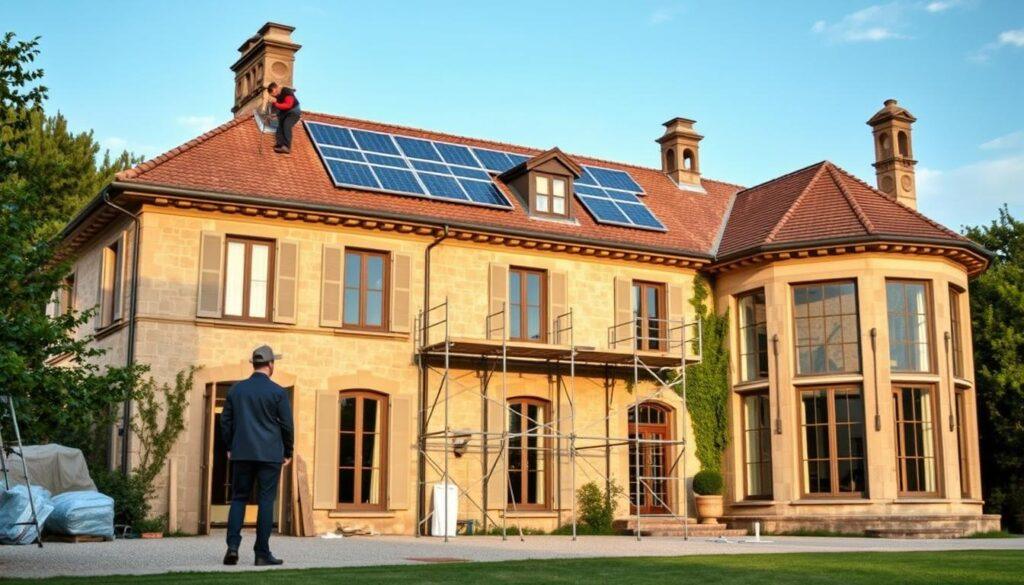
The real magic is in the unseen layers. Insulation and air sealing are the silent warriors of comfort. Blowing insulation into walls, sealing attic floors, and weather-stripping doors can dramatically improve your home. Adding a high-efficiency HVAC system makes your villa behave like a modern home.
Look to projects like the Art Curator’s Sustainable Midcentury Beach House for inspiration. It uses passive solar design to manage heat gain. It integrates green tech subtly, not loudly.
The ultimate goal of any historic villa restoration is to give the building a new lease on life. You want it to be as efficient and comfortable as new construction, while keeping its unique soul. For more sustainable strategies, check out our eco-friendly villa renovation guide. It’s a big task, but it’s the difference between preserving a museum piece and making a home for the next century.
Material restoration vs. replacement decisions
The toughest choices in a luxury home renovation aren’t about colors. They’re about saving old materials or throwing them away. Sentiment meets the budget in this decision.
Do you fix or replace? Your choice shapes the project’s heart and its cost.
Restoring is like giving a building a second chance. It means finding experts to fix old materials. The patina—the wear that tells the building’s story—is kept. This approach offers unmatched authenticity but comes with a high price.
Replacing is more practical. Swapping old glass for new, clear units makes sense for light and efficiency. But, it risks losing the space’s unique feel. A wrong choice can make the space feel empty.
The best approach often mixes both. This isn’t a compromise but a careful selection. You save the most important features and update others to keep the space’s spirit.
| Approach | Philosophy | Cost Implication | Visual Outcome |
|---|---|---|---|
| Restoration | Preserve the original fabric and history at all costs. | High (specialist labor, rare materials) | Authentic, layered, tells a continuous story. |
| Replacement | Prioritize function, efficiency, and modern performance. | Variable (can be lower, but quality materials cost) | Clean, uniform, but can lack historical depth. |
| Hybrid Strategy | Curate: save the iconic, update the practical. | Managed (high investment on key pieces, sensible elsewhere) | Cohesive and respectful, blending narrative with comfort. |
Think of it like film restoration. Experts clean and stabilize the original print. They don’t change the story. Your villa deserves the same care.
Your choices set the stage for the project. A well-made decision provides a perfect backdrop for sophisticated spaces. It’s the foundation of architectural preservation—knowing what to hold onto and what to let evolve.
Integrating modern technology with period architecture
Adding smart home tech to an old villa might seem odd. It’s like mixing a jet engine with a horse-drawn carriage. But, the goal is to make it work, not to look like a renovation. It’s about blending old charm with new tech.
This isn’t about showing off gadgets. It’s about creating a better living space. The tech should work smoothly, without being seen. Your home should be smart but look like it’s from another era.
Where do you start? With the basics. For example, replace old windows with clear, double-paned historical replicas. This keeps the look but adds modern benefits. It’s all about quality without showing off.
The key to architectural preservation today is to blend in, not stand out. We’re talking about:
- Climate Control: Hidden air handlers and smart thermostats that save energy.
- Audio-Visual: Speakers and screens that hide in plain sight.
- Lighting & Shading: LED lights and shades that add ambiance without being seen.
- Security & Access: Cameras and locks that look old but work new.
The phone is the one thing we all show off. It controls the hidden tech. This way, the old charm of your home stays the main attraction.
| Visible Tech (The Competitor) | Invisible Tech (The Enhancer) |
|---|---|
| Plastic white smart speaker on a marble mantel. | Audio streamed through in-ceiling speakers with paintable grilles. |
| Bulkier modern window unit slapped into a vintage frame. | Motorized, ultra-thin shades hidden inside the window jamb. |
| Network routers and cables sprawled on a historic desk. | Centralized network hub in a basement closet with in-wall wiring. |
| Glaring LED downlights drilled into ornate ceiling plaster. | Adjustable LED tape in coves providing soft, indirect illumination. |
| Chunky touchscreen control panel on a wallpaper wall. | Voice control or a discreet, app-based interface on your personal device. |
Living in a home that’s both old and new is possible. It requires careful planning. You need to think ahead and hide the tech.
This approach shows true respect for architectural preservation. It keeps the original look while adding modern comforts. It’s a smart way to mix old and new without it looking out of place. Your home isn’t just fixed; it’s brought back to life.
Working with specialists: architects, contractors, and preservation experts
Think of your project as a big movie. You’re the big boss, not just a small part. Choosing the right architect, contractor, and preservation expert is key.
An historic villa restoration needs a master like a film’s cinematographer. They see old details as priceless. You also need a writer who knows both old stories and new ones. Teams like Nest Architects or the A. Quincy Jones revival team are great examples.
In your luxury home renovation, you’re the conductor. Find a builder who respects old craftsmanship. Keep a preservation expert to follow local rules. You set the pace and the vision.
A great historic villa restoration mixes old and new perfectly. This magic is what makes a luxury home renovation stand out. Your choice is not just about the details. It’s about finding the right team to create something new.