

Welcome to the world of threshold magic, where interior comfort meets nature’s beauty. Imagine a space that brings the outdoors in, turning your home into a sanctuary. It’s not just about looks; it’s about creating a soulful experience.
We’ll explore new ideas and practical tips to enhance your space. From bi-fold glass walls to smart lighting, every detail counts. It’s a balance between structure and nature, creating a perfect environment.
Ready to start this journey? We’ll show you how to make spaces that are both useful and stunning. You might get inspired to change your own space, using top designers’ best practices. Want to see what’s possible? Check out our guide on signature villa designs for inspiration.
Key Takeaways
- Seamless transitions enhance the overall aesthetic and functionality of your space.
- Bi-fold glass walls provide exceptional visibility and energy efficiency.
- Thoughtful lighting strategies can transform the atmosphere of any area.
- Material continuity creates a cohesive look between spaces.
- Incorporating nature can significantly reduce stress and improve well-being.
Site reading wind sun privacy noise views neighbors and wildlife
To design well, listen to the land’s natural rhythms. The landscape is more than a backdrop; it’s alive and tells you what it needs. Indoor-outdoor living works best when you listen to it. Scrolling Pinterest won’t help you avoid bad design choices.
Stand on your land at dawn, noon, and dusk. Notice the wind direction and where neighbors can see in. These questions are key to good design.
Think about the nearby oaks. Will they make your terrace dusty in spring? Many indoor outdoor villa projects fail because of bad sun placement. It’s all about knowing the sun’s path and the climate.
The Nellis Architecture team says, “Indoor-outdoor living needs architecture, landscape, and climate to work together.” Start by listening to the land. Wildlife corridors, breezes, and street noise are part of the design, not problems to solve.
Frank Lloyd Wright said, “The site makes the building.” He was right, but remember, ignoring the site can ruin the building. Before we talk about doors or outdoor kitchens, remember: the line between inside and out starts with your feet on the ground and your ego in check.
| Factor | Importance | Impact on Design |
|---|---|---|
| Wind | High | Affects comfort and energy efficiency |
| Sun | High | Influences heat gain and lighting |
| Privacy | Medium | Essential for personal comfort |
| Noise | Medium | Impacts tranquility and relaxation |
| Views | High | Enhances aesthetic value and experience |
Openings sliders pivot walls cornerless glazing and bug screens
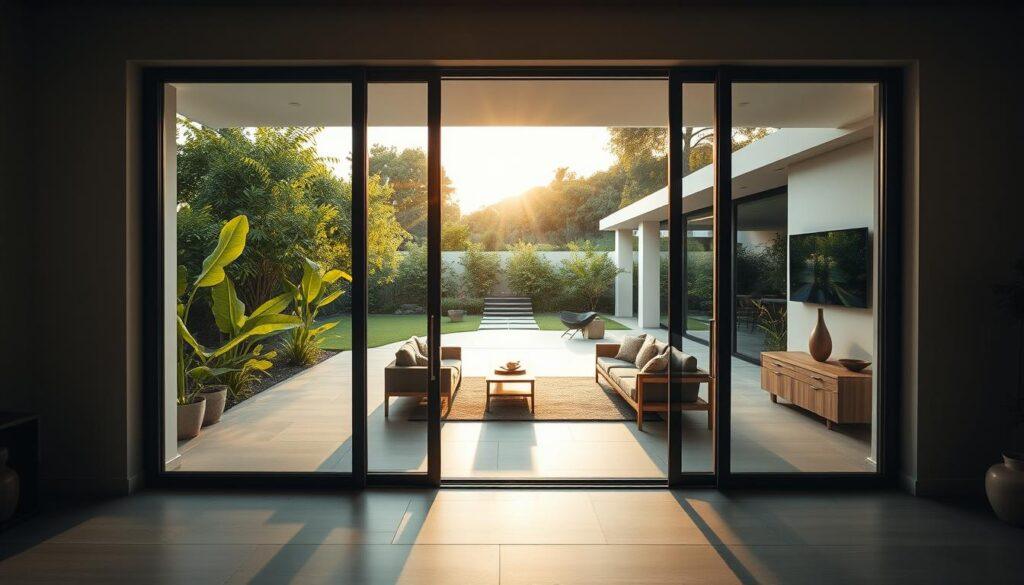
Imagine a wall that can just melt away, blending inside and outside seamlessly. That’s what disappearing doors offer. They’re not just sliding doors from the store. They’re high-tech systems that turn living rooms into outdoor spaces, creating a single, open area.
Picture a six-panel slider sliding open with just a whisper. It’s not just a cool feature; it’s a big change. The tracks are hidden in the floor, so the floor is smooth. You can move from inside to outside without any bumps or breaks.
The frames of these systems are cleverly designed. They’re thin but strong, handling wind loads well. Pivot walls are another cool option. They spin around a central point, making openings that feel like a surprise.
Bug screens are also key for indoor-outdoor living. They keep out pests like sand flies and mosquitoes. These screens hide in the same spots as your windows, making your outdoor space bug-free.
| Feature | Benefit | Considerations |
|---|---|---|
| Disappearing Doors | Seamless transition between spaces | Requires precise installation |
| Pivot Walls | Theatrical cornerless openings | May need additional space for rotation |
| Bug Screens | Insect protection without obstruction | Regular maintenance needed |
Shade devices loggias deep eaves pergolas louvers fabrics and vines
Shade is not just a luxury; it’s essential for outdoor living. It turns your outdoor areas into cozy spots for relaxation. Let’s look at the key elements for effective shading.
The loggia is more than a “covered patio.” It’s a space that controls light and heat. It’s like a personal air-conditioned area, letting you enjoy the outdoors without direct sunlight.
Deep eaves are also important. They extend your roofline, providing a shaded area. This simple addition lets you enjoy the outdoors for more months. It’s a smart use of geometry.
Operable louvers are another great option. They let you control sunlight in your space. Open them for warmth in winter, close for glare in summer, or adjust for the perfect light. It’s like controlling nature with a remote!
Don’t forget pergolas with climbing vines. They offer a natural way to shade your space. Plant vines like wisteria or grapevines, and in a few years, you’ll have a living ceiling. It’s a beautiful and comfortable addition.
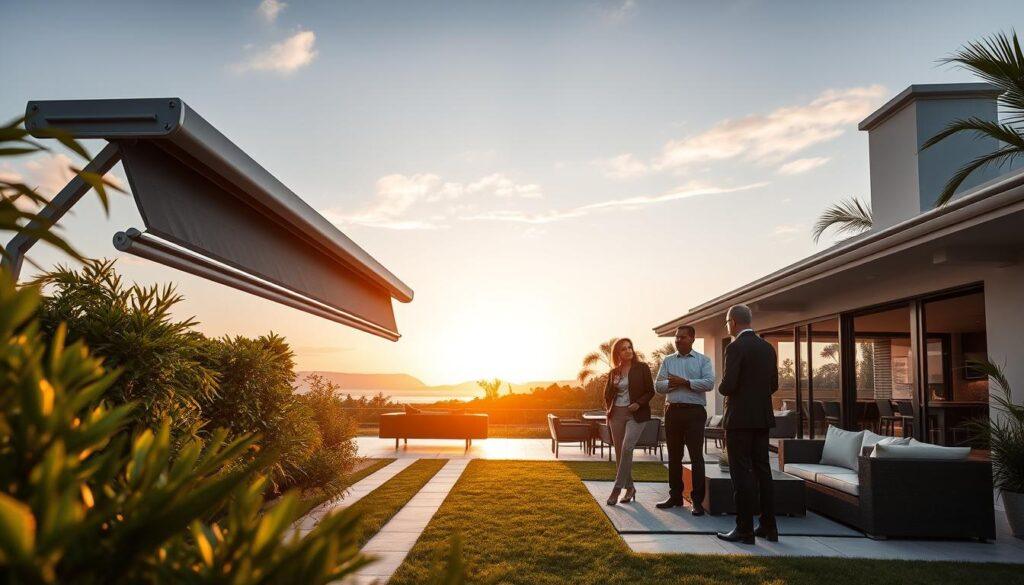
Fabrics like retractable awnings, shade sails, and outdoor curtains are also key. They can change your space in minutes. They soften architecture and add a touch that metal and wood can’t. They’re perfect for a cozy feel.
As the Nellis Architecture team says,
“Shading is not an accessory. It is a necessity.”
In places like the Gulf or the American Sun Belt, good shading is vital. It turns a terrace from something you admire to something you enjoy.
For more on creating perfect outdoor spaces, see courtyard typologies and microclimate mapping.
Outdoor rooms dining lounge fire pit kitchen pool cabana and spa zones
Imagine a place where cooking and relaxing meet under the stars. Outdoor rooms have become key parts of our homes, changing how we enjoy nature. The outdoor kitchen is more than a grill; it’s a place for cooking up a storm with gas grills, pizza ovens, and teppanyaki plates.
Nellis Architecture says shaded outdoor rooms are great for months. The outdoor kitchen is at the heart of this change. Cook from breakfast to dinner outside, while friends enjoy drinks nearby. The dining area should be close to the kitchen but far enough for comfort.
A pergola adds coziness, and a fire pit brings warmth and charm. People love fire; it’s natural. Arrange seats around the fire pit for better conversation and connection. It’s not just eating outside; it’s dining in a luxurious spot.
The lanai is a mix of indoor comfort and outdoor beauty. It makes you want to stay longer. Enjoy coffee in the morning or cocktails at night. It connects the kitchen to the pool, making your outdoor space flow smoothly.
The pool cabana and spa zone are the highlights of your outdoor space. They offer shaded spots for relaxing and changing without going inside. Imagine a spa in your backyard with water features and greenery. The goal is to make these areas feel connected yet spacious, improving your experience.
| Outdoor Room Feature | Description | Benefits |
|---|---|---|
| Outdoor Kitchen | Fully equipped for outdoor cooking | Enhances outdoor dining experience |
| Lanai | Transitional space between indoors and outdoors | Encourages lingering and relaxation |
| Fire Pit | Central gathering spot with seating | Fosters conversation and warmth |
| Pool Cabana | Shaded area for changing and lounging | Offers privacy and comfort |
| Spa Zone | Relaxation area with water features | Creates a resort-like atmosphere |

Floor continuity stone to stone deck transitions drains and slip ratings
The veranda is a big test for seamless transitions. It’s where indoor stone meets outdoor stone. A small lip can ruin the feeling of indoor-outdoor living.
It seems simple: use the same stone inside and out. But, exterior stone needs a slip rating that interior stone doesn’t. We need a stone that’s safe even when wet.
Honed travertine is great indoors, while tumbled or brushed is better outside. They look similar, but perform differently. Drainage is key to keeping the veranda dry.
Linear drains help by catching water before it reaches the house. The slope should be gentle, about a quarter-inch per foot. A steeper slope feels like dining on a boat.
Stone’s thermal properties are important for comfort. Travertine and limestone stay cool, while granite holds heat. Choose your veranda flooring wisely, like picking a summer shirt.
Year round use heating misting retractable screens and storm prep
Outdoor living should be enjoyed all year. But how do we handle Mother Nature’s changes? The answer lies in smart design and clever engineering. With the right approach, your patio can be comfortable any season.
In the Gulf, summers are hot, while the Northeast gets cold winters. But don’t worry! Heating solutions can make your outdoor space usable longer. Infrared heaters, for example, warm people directly, saving energy. It’s like having a campfire at your fingertips—cozy and efficient.
When it’s hot, misting systems come to the rescue. They create a fine fog that cools the air by up to 15 degrees. This keeps your outdoor space comfortable without getting wet.
Retractable screens are also key. They keep bugs away, protect from wind, and offer privacy. Motorized screens are great because they hide in ceiling housings with just a button.
Preparing for storms is important. Outdoor kitchens need secure appliances, and furniture should be easy to move or heavy enough to stay put. The goal is to keep everything safe without making patio chairs fly off!
To wrap it up, here’s a table with essential strategies for outdoor living all year:
| Strategy | Description | Benefits |
|---|---|---|
| Heating | Infrared heaters for direct warmth | Extends outdoor season, energy-efficient |
| Misting | High-pressure systems for cooling | Reduces temperature, keeps surfaces dry |
| Retractable Screens | Temporary enclosures for privacy | Flexible space usage, easy to operate |
| Storm Prep | Secure appliances and lightweight furniture | Prevents damage, ensures safety |
With the right planning, you can enjoy indoor-outdoor living all year. Designing for comfort is not just smart; it’s essential.
Furnishings performance fabrics quick dry foams teak powder coat metals
Outdoor furniture has come a long way. It’s no longer flimsy but now elevates our living spaces. No more settling for cheap-looking chairs. Today, we have durable and stylish performance fabrics.
Solution-dyed acrylics are a great example. Brands like Sunbrella offer fabrics that resist fading and water. They feel like cotton but are actually durable. This is a big improvement!
Quick-dry foams are another game-changer. They drain water fast, so your cushions stay dry. No more damp seats after a rainstorm.
Teak wood is the top choice for outdoor furniture. It weathers to a beautiful gray and resists rot and insects. Just make sure it’s ethically sourced.
Powder-coated aluminum frames are light yet durable. The finish is tough and long-lasting. You can choose colors that match your outdoor style.
Nellis Architecture says these materials age well. They handle heat, salt, and sand. Your outdoor furniture should look better over time, not worse.
| Material | Durability | Maintenance | Aesthetic Appeal |
|---|---|---|---|
| Performance Fabrics | High | Low | Stylish |
| Quick-Dry Foams | High | Low | Functional |
| Teak | Medium | Medium | Elegant |
| Powder-Coated Aluminum | High | Low | Modern |
Sound and lighting layers ambient task accent path and dark sky rules
Imagine stepping into your outdoor oasis, where sound and light dance harmoniously. The right lighting transforms a dull space into a vibrant retreat. It’s not just about illuminating the area; it’s about creating an atmosphere that invites lingering.
Layered lighting is key. Think of it as a symphony: each layer plays its part. Ambient lighting provides the overall glow. Consider indirect LED strips tucked under benches or downlights hidden in pergola beams. These fixtures bounce light off surfaces, creating a soft glow.
Next, we have task lighting. This is essential for specific activities, like grilling or dining. It ensures that your outdoor bar or dining table is well-lit, making those evening gatherings enjoyable.
Then comes accent lighting, the show-off layer. This includes uplighting a stunning tree or grazing a stone wall to reveal its texture. It’s about highlighting the beauty of your space.
Don’t forget path lighting. It’s the safety net of your outdoor area. Low-level bollards or recessed step lights prevent guests from discovering the koi pond in an unfortunate way.
Now, let’s talk about sound design. This often gets overlooked, but it’s vital. Water features, like a simple fountain, can mask unwanted noise, creating a calming atmosphere. Buried outdoor speakers can enhance this experience. Set them to a low volume, allowing conversation to flow without competing with bass frequencies.
The goal isn’t to recreate an indoor media room; it’s about crafting a soundscape that makes silence feel intentional. Remember, following dark sky rules is essential for both ecological reasons and your own enjoyment of the night sky. Fixtures should direct light downward, keeping the stars visible.
For more insights on effective lighting design, check out this landscape lighting design principles guide.
Storage towel trunks grill drawers plant room and service yard
Storage is the unsung hero of your outdoor room. It keeps everything in order. Integrated storage solutions are key for a seamless indoor-outdoor living experience. Without storage, an outdoor space looks great at first but soon gets cluttered.
Towel trunks are more than furniture; they’re essential for keeping pool towels dry and within reach. They need air to avoid mildew. Place them near the pool exit to avoid a wet and chaotic search for towels.
Grill drawers are the heroes of the outdoor kitchen. They offer easy access to utensils, spices, and tools. Use marine-grade stainless steel slides and soft-close mechanisms to keep things organized and prevent messes.
The plant room or service yard is the hidden area that guests shouldn’t see. It holds pool equipment and garden tools. Place it near the side yard or garage, and screen it with fencing or hedging. A durable floor is essential for handling soil and tools.
The idea is simple: hide the engineering. Just like Nellis Architecture suggests, make visible spaces effortless. The hard work should be hidden from view. Remember, “Storage is the architectural equivalent of the bass player in a rock band—nobody notices when it’s done well, and everyone notices when it’s missing.”
Maintenance sealing cleaning seasonal swaps and hardware care
The living threshold changes with the seasons. It needs constant care. Imagine if stone could seal itself or fabrics could shake off pollen easily. Sadly, this isn’t true.
Sealing stone surfaces is vital. Travertine, limestone, and granite need a sealer every 12 to 18 months. This step blocks stains from wine or grease. Without it, stains can ruin your space.
Cleaning is a seasonal task. Spring brings pollen and pressure-washing. Summer means checking for mildew in shaded spots. Fall is for leaf removal to avoid tannin stains. Winter is for inspecting grout lines and drainage.
Hardware care is also key. Clean sliding door tracks to remove grit. Lubricate pivot hinges and keep screen tracks clear. A small issue today can turn into a big problem by August if ignored.
Seasonal swaps, like changing covers or moving heaters, mark time’s passage. They connect us to nature. By doing these tasks, we care for our space, keeping it lively and part of our home.
In the end, taking care of the threshold is essential. It’s the bridge between indoors and outdoors. With proper care, it will bring beauty and function for years.