

We’ve all felt that deep connection to wood. It’s the warmth of a cedar sauna, the strength of an oak beam, and the beauty of a white oak floor. This romance is as old as civilization. But in today’s world, it raises questions. Is the beauty worth the environmental cost or the sadness of it decaying quickly?
The modern lumberyard is different. Choosing a species is no longer just a simple task. It’s a Game of Thrones for timber, where only the strongest and most responsibly sourced materials make the cut. The key questions are: Is it real? Is it responsible? And will it look good in 20 years?
We no longer guess. Today, we have clear guidelines. Certifications like FSC and PEFC protect against irresponsible forestry. New technologies offer amazing options. Thermally modified wood is stable and insect-resistant, while Accoya is incredibly durable. Cedar cladding is also a top choice, known for its lasting beauty.
For those wanting beauty and durability, wood cladding is a great option. It’s sustainable and beautiful. The secret is to look beyond the surface to the science and sourcing, ensuring your choice is both durable and ethical.
Certification 101 (FSC/PEFC) and Chain-of-Custody Basics
In today’s world, labels like “eco-friendly” or “green” don’t always mean what they seem. They’re often just marketing tricks. When it comes to wood, you need more than just labels. You need proof that the wood didn’t harm the environment.
FSC and PEFC are not just logos. They are complex systems that check if wood is really sustainable. They make sure the wood didn’t harm forests or ecosystems.
The Paper Trail to Sustainability
Sustainability certification is like solving a mystery. It follows the wood from the forest to your home. It’s not just marketing; it’s real proof of sustainability.
FSC: The Gold Standard for Forest Management
The Forest Stewardship Council (FSC) is like the gold standard for wood. It was created to protect forests and workers. Choosing FSC wood means you support conservation.
PEFC: The Global Standard for Sustainable Forest Management
PEFC is like FSC’s democratic cousin. It works with local experts to ensure wood is sustainably managed. It’s strong in Europe and helps small forest owners.
Chain of Custody: More Than Just a Receipt
A chain of custody (CoC) certificate is like a digital trail for trees. It proves wood is certified from start to finish. It ensures wood is not mixed with illegal or harmful wood.
| Certification Body | Focus & Philosophy | Governance & Structure | Chain of Custody Model |
|---|---|---|---|
| FSC (Forest Stewardship Council) | Global, principle-based system with strong environmental and social criteria. Often seen as the activist, “gold standard” for conservation. | Membership-based with environmental, social, and economic chambers. Decentralized but with a strong, singular international standard. | Product-based. Tracks certified material through the supply chain via a credit or percentage-based system. Stringent and specific. |
| PEFC (Programme for the Endorsement of Forest Certification) | Framework for endorsing national systems. Focus on locally-adapted, regionally-managed forestry, often supporting small, private forest owners. | Umbrella organization that endorses national systems that meet its benchmark. More decentralized, federation-style governance. | Offers both product and credit systems. Often uses a “mass balance” or “percentage claim” approach for mixed materials. |
So, what does this mean for your project? It means you can demand proof. Beautiful FSC wood or PEFC-certified decking isn’t just a promise. It’s a material with a clear conscience. In a world of green noise, these certifications protect your project from harm.
Species Guide: From Classic White Oak to Modern Marvels
Forget sidekicks – in the epic of your villa’s construction, your wood species aren’t just materials; they’re the Avengers of your architectural team, each with a unique origin story and superpower. Selecting the right one isn’t a mere specification; it’s a casting call for the lead role in your home’s story. Forget the boring spec sheet. We’re drafting a character sheet for your build, where white oak is the Captain America of the lineup: reliable, strong, and classically heroic.
But every hero has a flaw, a kryptonite. The sun, the salt, the relentless coastal elements—these are your villains. The right wood isn’t just a pretty face; it’s a shield. Let’s meet the team.
White Oak: The Stalwart Classic
If your timber could wear a star-spangled shield, it would be white oak. This is your Captain America: strong, principled, and timeless. It’s the reliable choice that has defended American homes for centuries. Its tight grain and high tannin content give it a natural resistance to decay and moisture, making it a solid, if traditional, choice for beams and structural accents. It’s not the flashiest, but it’s the one you want when the architectural chips are down. It’s the hero you know will get the job done, no matter the coastal storm.
Cedar: The Fragrant Defender
Think of cedar cladding as your Black Widow: independent, naturally resistant, and with a signature scent that announces its presence. This is the “fragrant defender.” Its natural oils and aromatic compounds are its superpower, making it highly resistant to rot and insects.
But, like a lone-wolf spy, it doesn’t play well with others. It’s essential to use stainless steel or hot-dipped galvanized fasteners—coastal hardware is non-negotiable here, as cedar’s natural acids can corrode ferrous metals. It’s a loner, but a fiercely effective one.
Ash (TMW): The New Challenger
Enter the Iron Man of the lineup: Thermally Modified Wood (TMW), often using Ash. This isn’t just wood; it’s science. Through a precise, high-heat process (the “Repulsor Reactor” of the timber world), the wood’s sugars are caramelized, making it indigestible to fungi and insects. The result? Ash (TMW) offers stability and durability that rivals tropical hardwoods. It’s the tech upgrade—scientifically enhanced for superior performance, in the high-humidity, salt-air environment of a coastal home.
Accoya: The Alchemist’s Wood
If alchemy were a wood, it would be Accoya. This is Doctor Strange-level sorcery. Through a process called acetylation, the wood’s cellular structure is permanently altered at a molecular level. This “molecular makeover” swaps water-loving hydroxyl groups for acetyl groups, making the wood dimensionally stable and incredibly durable. It’s not just a finish; it’s a transformation. For coastal applications, Accoya laughs in the face of salt spray and resists rot like a sorcerer repelling eldritch magic. It’s the premium choice when failure is not an option.
Teak Alternatives: Beauty Without the Guilt
Traditional teak is the old-world aristocrat of woods, but its sourcing is often a tale of ecological and ethical complexity. The modern, conscious builder looks for heroes with a cleaner origin story. Enter the alternatives: thermally modified woods (like the Ash TMW above), premium teak alternatives like thermally modified Accoya, or even high-performance composites for specific applications. You get the rich, warm aesthetic without the complex supply chain or the guilt. It’s about achieving that golden, timeless look while letting the rainforest canopies remain intact.
| Species/Type | Coastal Durability | Maintenance Level | Ideal Use Case | Relative Cost |
|---|---|---|---|---|
| White Oak | High (with treatment) | Medium | Structural Beams, Interior Accents | $$ |
| Cedar | Medium-High (Natural oils) | Low | Siding, Cladding, Pergolas | $$ |
| Ash (TMW) | Very High | Very Low | Decking, Cladding, High-Moisture Areas | $$$ |
| Accoya | Exceptional | Very Low | Cladding, Windows, Doors, Marine | $$$$ |
| Teak Alternatives | Varies (Material Dependent) | Low to Medium | Decking, Outdoor Furniture | $$ – $$$ |
So, who gets the part in your coastal drama? The classic, stoic hero? The scientifically enhanced challenger? The alchemically perfected marvel? The choice isn’t just about picking wood; it’s about casting the right character for the leading role in your home’s story.
Battling the Elements: Cladding, Pergolas & Shutters
Forget the interior for a moment. When you’re building on the coast, your home’s exterior is more than just a facade. It’s the frontline against sun, salt, and sea. Every board, every joint, every fastener fights in this daily battle.
This isn’t just about looks. It’s a tactical defense. Your home’s exterior is a fortress against the elements.
The Sun, The Rain, The Salt: Picking Your Battles
Your coastal villa is like a fortress. The sun bleaches color and bakes wood. The rain probes for any weakness. And the salt corrodes from within.
The strategy isn’t to build a bunker. It’s to build smart. You’re choosing materials for a long, specific war.
Cladding: The First Line of Defense
Your cladding is the shield wall. It takes the first and hardest hits. Forget woods that can’t handle the sun.
Accoya and thermally modified woods like ThermoWood are the special forces. They resist UV rays and rot. A 50-year cladding system is a smart investment.
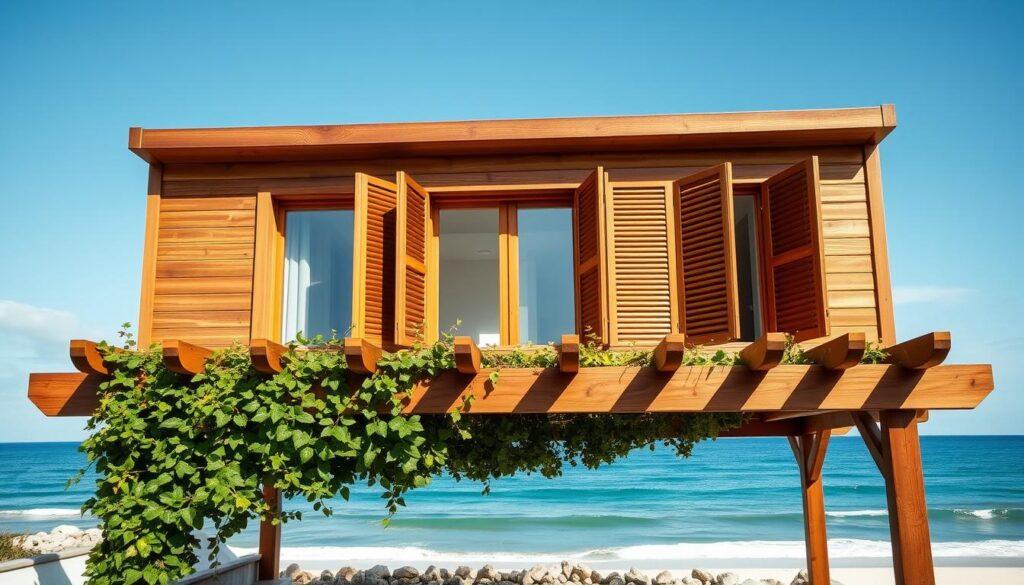
For a modern, low-maintenance fortress, Wood-Plastic Composites (WPC) are the tech-savvy choice. WPC is “highly resistant to moisture, UV rays, and insects”. It’s practical and offers UV and fade resistance without annual maintenance.
Pergolas: The Art of Dappled Shade and Structure
A pergola is architecture’s most elegant paradox. It provides the idea of shelter while letting elements in. On the coast, it’s a stress test for joinery.
A pergola must look delicate but withstand winds and salt. The choice of wood and hardware is critical. You can’t just screw it together and hope.
The joinery must account for wood movement. A rigid joint will crack under coastal strain. The solution? Clever joinery and the right coastal hardware.
Shutters: More Than Just a Pretty Louvre
Functional shutters are the unsung heroes of coastal architecture. They’re not just decorative. They’re the rapid-deployment force against storms or sun.
The wrong hinge on a coastal shutter is like a rusty lock on a bank vault—it’s the first thing to fail. Every pivot, every hook, every latch must be marine-grade stainless steel.
Every. Single. One. This is the true meaning of coastal hardware. The louvers aren’t just for looks; they’re engineered to deflect winds while allowing light and air. The finish on the wood is critical, too.
A film-forming paint will fail, blister, and flake. A penetrating oil or stain, reapplied as part of a sensible maintenance plan, allows the wood to breathe and the finish to weather gracefully.
Ultimately, your exterior is a system. The cladding, the pergola, the shutters—they must work in harmony. It’s not just about picking a pretty wood; it’s about engineering a resilient, beautiful defense that will stand guard for decades. The battle with the elements is constant, but with the right materials and the right hardware, it’s a battle you can win.
The Interior Touch: Beams, Ceilings, and Doors
When you step inside, wood’s role changes. It’s no longer fighting the elements but adjusting to humidity and comfort. Wood interacts with your air conditioning and humidity levels. It’s not just a material; it’s alive, adapting to your home’s needs.
This is the art of interior wood. It’s about designing for movement and choosing finishes that let wood live and breathe.
Movement is Inevitable: Designing for Wood’s Breath
Wood absorbs and releases moisture, expanding and contracting with the seasons and your HVAC system. A beam might change size with the seasons. This movement is a natural part of wood.
Designing for this movement is key. Think of it as giving wood room to breathe. A 10-foot oak beam needs an expansion gap at the ends. Solid wood doors require proper clearances and finishes that move with the wood.
Modern materials like thermally modified woods or Accoya are great for critical applications. They help minimize movement. The goal is to design for silent and graceful movement, not loud pops and cracks.
The Finish Line: Oils, Waxes, and the Low-VOC Promise
The finish is like wood’s skin. The wrong one can trap moisture, causing problems. Modern finishes protect while letting wood interact with its environment.
Traditional finishes like polyurethane can crack when wood moves. Natural oils and hard-wax oils are better. They protect from within and let wood work with the seasons. Low-VOC and natural oil-based finishes are good for air quality and wood health. They offer a tactile, matte surface that ages well.
This approach is different from composite materials. While composites are low-maintenance, they lack authenticity and breathability. The trend is moving toward materials that tell a story and breathe.
Interior Wood Finish Comparison
| Finish Type | Breathability | Maintenance Cycle | Best For | VOC Level |
|---|---|---|---|---|
| Natural Oils (Linseed, Tung) | Very High | Annual to Biennial | Floors, countertops, high-touch surfaces | Low to Zero |
| Hardwax Oils | High | 3-5 years | Tables, kitchen tops, high-wear areas | Low |
| Natural Wax (Beeswax, Carnauba) | Medium | 1-2 years | Furniture, decorative beams, trim | Zero |
| Low-VOC Lacquer (Water-based) | Low | 5+ years | Doors, cabinetry, high-traffic areas | Low |
The interior touch is about partnership. You’re not installing a static material but a partner in your home’s climate. Choose a finish that lets wood breathe, move, and age with you. This creates a space that feels alive, not static.
The Alchemy of Modern Wood Treatments
Forget medieval potions and lead-into-gold fantasies. Today’s alchemy happens in vacuum kilns and chemical reactors. Here, wood is turned into a super-material. It’s not just staining or sealing; it’s a deep change at a molecular level.
We’re moving beyond finishes and into material science. Wood is now a high-performance component. Let’s explore the processes that make wood more stable, durable, and resilient.
Thermal Modification: Cooking Up Stability
Imagine a cooking show, but instead of a soufflé, you’re baking the wood’s structure. This is thermal modification. It creates thermally modified wood by baking it in a high-heat, low-oxygen environment.
This process caramelizes the wood’s sugars. It makes the wood inedible to fungi and insects. It also reduces the wood’s water absorption.
The result is not just rot resistance. It’s a profound change in the wood’s personality. Thermally modified wood is more dimensionally stable. It swells, shrinks, and checks less.
This isn’t a finish you apply; it’s a fundamental change in the wood’s character.
Acetylation (Accoya): The Molecular Makeover
If thermal modification is like baking, acetylation is a full molecular makeover. This is the science behind Accoya. It permanently alters the wood’s cell walls.
Think of it as giving the wood a non-stick, Teflon-like coating at a molecular level. The process swells the wood’s cells with a non-toxic, food-safe chemical (acetic acid). This permanently bonds to the wood’s cell walls.
This “molecular bulking” reduces the wood’s water absorption by up to 80%. The result is a material that is incredibly stable. It’s class 1 durable (on par with teak) and naturally resistant to rot and insect attack. Accoya isn’t just treated wood; it’s a new, more stable material.
Oil vs. Film-Forming Finishes: A Philosophical Divide
Once you have your engineered or chosen wood, the final alchemy is the finish. This is where a philosophical split emerges: the penetrating oils versus the film-forming finishes. It’s a debate of depth versus armor.
On one side, you have penetrating oils (like tung or linseed oil). They sink into the wood, hardening from within and enriching the grain. They don’t create a surface film, so the wood can breathe and move naturally. They age gracefully, wearing in, not just wearing off.
On the other side are film-forming finishes like polyurethane or lacquer. They create a protective, continuous film on the surface. This is armor plating: excellent at repelling water and stains, but when it fails, it fails catastrophically—cracking, peeling, and requiring a full strip-down to repair.
The choice is a design philosophy. Do you want a finish that lives with the wood, wearing in like a leather jacket? Or a shield that protects it from the world, until the day it fails? Your answer depends on whether you see the wood’s natural patina as a feature, or a flaw to be sealed away.
The Invisible Enemy: Managing Moisture Like a Pro
Water is like a sneaky ninja, always looking for ways to get in. It doesn’t crash in; it quietly seeps into tiny openings. To fight moisture, you need a layered defense, not a single seal. The key is to use the gap to your advantage.
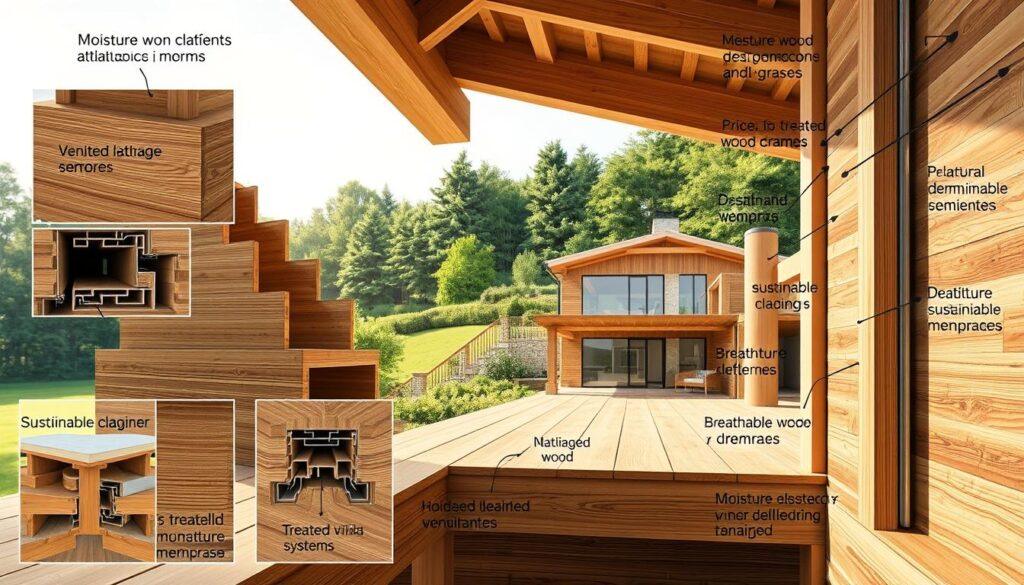
The Gap is Your Friend: Expansion, Ventilation, and Drainage
The heart of moisture management is understanding the gap. A drained and ventilated rainscreen system is smart. It lets water flow out and air in.
This system has a gap behind the cladding. When water gets in, it flows down and out. This also lets the wood breathe and move with humidity changes.
The Critical Details: Flashing, Drips, and End-Grain Sealing
Flashing is like armor for your building. It’s a system of overlapping pieces that keeps water away. The top piece always covers the one below, making it easy for water to flow.
The end grain of wood is very absorbent. Sealing it is like protecting a letter from the rain. A good sealer keeps moisture out, protecting the wood.
| Defensive Tactic | How It Works | Why It’s Critical |
|---|---|---|
| Drained & Back-Ventilated Rainscreen | Creates a drainage plane and air cavity behind the cladding to let water drain and air circulate. | Prevents trapped moisture, allows the structure to dry, and relieves vapor pressure. |
| Proper Flashing & Drip Edges | Metal flashing is installed with a kick-out or drip edge to direct water away from the structure. | Intercepts water and directs it away from the building, protecting the vulnerable end-grain and joints. |
| End-Grain Sealing | Applying a penetrating sealer to the cut ends of wood boards. | Armors the most absorbent part of the wood, slowing moisture and rot. |
This isn’t just about stopping water; it’s about managing it smartly. You’re not building a fortress. You’re creating a system that outsmarts the enemy and keeps your building safe.
The Real Cost: Longevity Math vs. Composites & Aluminum
Forget the initial quote. The true cost of your villa’s exterior isn’t just the deposit. It’s the decades-long tab for upkeep, repairs, and the looming specter of replacement. This is the ledger of longevity, where savvy design is measured in decades, not just dollars.
Forget the initial quote. The true cost of your villa’s exterior isn’t the deposit; it’s the decades-long tab for upkeep, repairs, and the looming specter of replacement. This is the ledger of longevity, where savvy design is measured in decades, not just dollars.
The Initial Sticker Shock vs. the 20-Year Ledger
We’re conditioned to see the price tag. A magnificent Ipe deck or a sleek composite system each has a number. But that number is a mirage. True cost accounting starts the day after installation. A premium wood like Ipe may have a high entry fee, but its 40+ year lifespan with minimal care tells a different story over 30 years. The real math isn’t purchase price; it’s the sum of all future costs.
Let’s run the numbers. A simple 25-year cost analysis often reveals a shocking inversion: the “cheaper” option can become a money pit.
| Material | Initial Cost (per sq. ft.) | Annual Maintenance Cost | Estimated Lifespan | Projected 25-Year Cost* |
|---|---|---|---|---|
| Premium Hardwood (e.g., Ipe, Cumaru) | High | Low (Oil every 2-3 yrs) | 30-50+ years | $$ (Lower long-term) |
| Thermally Modified Wood (e.g., Thermory) | Medium-High | Very Low | 25-40 years | $$ |
| Wood-Plastic Composite (WPC) | Medium | Low (Cleaning) | 20-30 years | $$ |
| Aluminum (Cladding/Louvres) | Medium-High | Negligible | 50+ years | $ (Lowest long-term) |
*Costs are illustrative, showing relative comparison over a 25-year period including material, installation, and projected maintenance.
Composites: The Low-Maintenance Mirage?
Composite decking and cladding are the siren song of the “maintenance-free” promise. The sales pitch is alluring: no staining, no splinters, no rot. But the “low-maintenance” label can be a mirage. While you may not be sanding and oiling, these materials are not immune to the elements.
They can fade, stain, and in some cases, warp or stain over time. Their 20-30 year lifespan is solid, but it’s not a “set it and forget it” lifetime guarantee. The initial cost is attractive, but the 25-year ledger must include the cost of fading and the eventual, total replacement cost that wood or metal might not require for decades longer.
Aluminum: The Cool, Industrial Counterpoint
Enter aluminum: the cool, industrial counterpoint. For louvres, soffits, and modern cladding, it presents a different equation. The initial cost for a high-quality, powder-coated aluminum louvre system is significant. But its annual maintenance cost is near zero—it won’t rot, rust (if treated), or require sealing.
Its 50+ year lifespan and near-zero upkeep mean its line on the 25-year ledger is often the flattest and most predictable. It’s not trying to be wood; it’s the industrial, low-fuss, high-durability play. In the longevity math, aluminum often wins on total cost of ownership for applications where its aesthetic fits the vision.
The choice isn’t about good vs. bad, but about running the numbers for your specific 20-year vision. Is your priority a timeless, organic warmth that asks for care, a low-touch composite that may need a full swap in 25 years, or a sleek, industrial metal that simply outlasts the mortgage? The real cost is the sum of the receipt, the labor, and every can of sealer or power wash you’ll ever buy.
The Lookbook: Material Palettes for the Modern Villa
Forget about paint swatches and fabric samples. The true soul of a modern villa is in its materials. It’s not just about colors. It’s about the feel and look of wood, stone, and metal.
Choosing materials is more than just picking colors. It’s about creating a sensory experience. It’s a story told through the texture and feel of each material.
Wood + Stone: The Primordial Pairing
Wood and stone are architecture’s original power couple. Cedar cladding’s warmth meets limestone’s ancient strength. It’s like a forest floor meeting a mountain face.
The warmth of wood contrasts with stone’s coolness. Wood’s vertical grain meets stone’s textured plane. Wood breathes, while stone is steady. This mix grounds a modern structure, linking it to the past.
Wood + Metal: The Industrial Tango
Wood and metal have a modern, rhythmic dance. A blackened steel frame meets a Douglas fir ceiling. Metal’s sharp lines meet wood’s warmth.
This mix isn’t cold. It’s a warm industrialism. Metal’s precision is softened by wood’s patina. It’s like a tailored suit, with metal as the structure and wood as the lining.
Wood + Plaster: The Textural Tango
This pairing is for those who love texture. Imagine smooth plaster next to rift-sawn oak. Plaster is calm, while wood adds texture.
Plaster is a quiet canvas. Wood’s grain and color make it the star. It’s a textural duet, where one enhances the other’s beauty.
The Contractor Brief & The Care Manual
To make your wood project last, you need to write a clear plan. Think of it as a simple guide that protects your dream from the real world.
The One-Page Project Brief for Your Builder
This is your detailed guide. Don’t just say “install wood.” Tell your builder to use marine-grade stainless steel or galvanized fasteners for coastal projects. This is coastal hardware that stands up to salt.
Also, specify a high-quality sealant and the exact ventilation gap needed. This document is your first line of defense against problems.
The 5, 10, and 20-Year Maintenance Checkpoints
Wooden structures need care, not to be forgotten. Your maintenance plan is a way to honor them. It’s a conversation with a living material, not a chore.
Year 1-5: Do an annual check-up. Clean and look for moisture signs. It’s a routine, not a crisis.
Year 5: Reapply a penetrating oil finish to all exterior surfaces. It’s a treatment, not a chore. Year 10: Do a full inspection. Check fasteners and ensure drainage and ventilation gaps are clear. This shows that wood, with care, lasts longer than any fake maintenance-free option.