

Modular outdoor kitchens have become a serious planning category for homeowners, not just a backyard upgrade with a grill and a counter. In 2026, the main question is not whether outdoor cooking spaces are popular; the better question is whether the scope, materials, utilities, and installation plan make financial sense for the specific home. I would treat ROI as a range, not a promise, because cost recovery depends heavily on climate, neighborhood expectations, build quality, and how well the kitchen fits the house.
The safest way to think about return is practical: control the product cost, avoid overbuilding for the market, and hire qualified trades for work that affects gas, electrical, plumbing, drainage, structure, or fire safety. A modular system can reduce some planning uncertainty, but it does not remove the need for careful site preparation or code-aware installation.
2026 Market Signals For Modular Outdoor Kitchens
Demand Is Real, But Demand Is Not ROI
Outdoor kitchens had a strong market signal in the 2026 data. Grand View Research projected the U.S. outdoor kitchen market at US$10,475.1 million in 2026, rising to US$18,221.2 million by 2033, with a projected 8.2% CAGR from 2026 to 2033 according to its U.S. outdoor kitchen market outlook. That supports the idea that homeowners are continuing to spend on outdoor cooking spaces.
Still, a growing market does not mean every project earns back its cost. In design work, I see the best planning decisions happen when homeowners separate two kinds of value: resale value and use value. Resale value is what a future buyer may pay for the feature. Use value is the real benefit of cooking, dining, and hosting outdoors. The two can overlap, but they are not the same measurement.
Modular Outdoor Kitchens Cost Context
On October 7, 2026, RTA Outdoor Living reported that its median product-only cost for a custom prefab outdoor kitchen rose 17.9% year over year, from $16,409 in 2025 to $19,355 in 2026. The same 2026 order dataset showed the middle 80% of orders ranged from $10,330 to $33,807, while half of all orders fell between $14,014 and $25,793, product-only and excluding installation, according to the company’s 2026 cost study.
The appeal of modular outdoor kitchens is that product pricing can be easier to define before crews arrive. That helps with budgeting, especially compared with a fully site-built masonry project where labor time, finish details, and field adjustments can expand quickly. But product-only pricing is not a full installed budget. Delivery, base preparation, utility extensions, appliance hookups, permits where required, and finish coordination can change the real number.
Cost Discipline And ROI Risk
Why Payback Is Local
The research notes for this topic included resale-recovery ranges from renovation and regional contractor sources, including national estimates around the midrange and warmer-climate estimates that were higher. I would treat those figures as planning signals rather than fixed outcomes. A kitchen in a warm climate where outdoor dining is common may be viewed differently from the same investment in a short-season market.
Neighborhood context also matters. If comparable homes commonly include built-in outdoor cooking areas, a restrained and well-integrated project may help the home feel complete. If the feature is unusual for the area, the buyer pool may value it less than the owner expects. For a deeper cost-recovery discussion in a similar planning lane, see this related piece on outdoor kitchen ROI planning.
Where Budgets Usually Drift
The product package is only one part of the risk. Budgets often drift when homeowners add refrigeration, sinks, shade structures, stone upgrades, longer utility runs, or entertainment features after the initial estimate. Grand View Research identified cooking fixtures as the largest product category share in the U.S. market data, at about 42.8% of market spend, and noted refrigeration units as the fastest-growing segment. Those details match what many homeowners feel in the showroom: appliances are the emotional center of the project, but they can quickly dominate the budget.
My cautious advice is to rank features before pricing finishes. If the grill, counter area, and safe landing space are the core, protect those first. If refrigeration is wanted, price it early rather than treating it as an add-on. If a sink is being considered, ask a qualified plumber and local authority what the water supply, drainage, and winterization implications are before committing to the layout.
Materials, Components, And Scope Choices
Frames, Counters, And Weather Exposure
For modular outdoor kitchens, the frame and cladding system should be evaluated as a weather-exposed assembly, not as indoor cabinetry moved outside. Homeowners should ask how the system handles freeze-thaw cycles, heat from cooking equipment, moisture, and cleaning products. The research notes support the 2026 trend toward modular and prefab frames because they can reduce on-site labor, improve cost predictability, and still allow finish choices. That is useful, but it does not excuse poor detailing at the patio, wall, or drainage plane.
Counter material deserves special care. Dark surfaces can become uncomfortable in full sun. Porous materials may require maintenance. Large overhangs may need support. None of those items are glamorous, but they decide how the kitchen feels after the first season of use.
Cooking, Cooling, And Counter Choices
Appliance selection should follow cooking habits, not catalog pressure. A homeowner who grills twice a week may benefit more from durable cooking equipment and generous prep surface than from several specialty appliances. A refrigerator can be helpful for entertaining, yet it also adds electrical load, weather-exposure concerns, and replacement cost. If the home is in a seasonal climate, ask how each component should be protected during months of low use.
- Spend first on safety and layout: heat clearances, ventilation, landing space, and stable surfaces matter more than decorative upgrades.
- Keep the footprint disciplined: larger kitchens are not automatically better for resale if they crowd patios or block circulation.
- Price utilities early: gas, electrical, plumbing, and drainage can affect the budget as much as visible finishes.
- Match the house: materials should relate to the home’s exterior so the project feels planned rather than added later.
DIY Boundaries And Professional Work
What A Homeowner Can Safely Handle
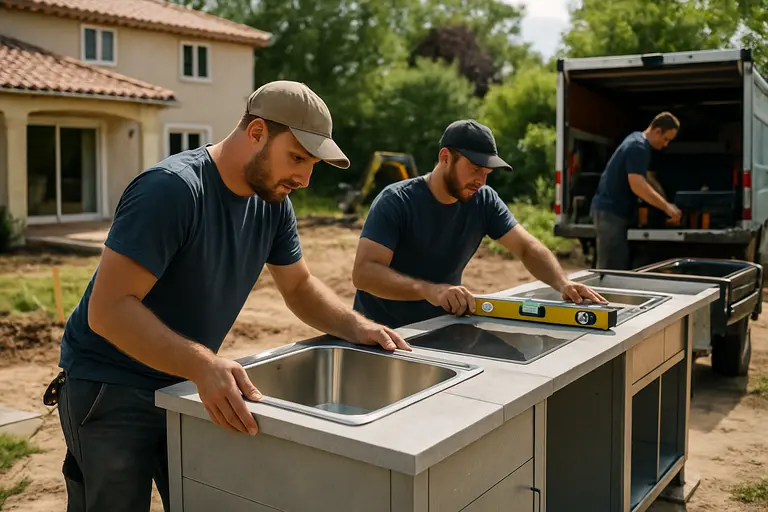
Some parts of an outdoor kitchen project can be reasonable for a capable homeowner: measuring the patio, comparing product specifications, collecting finish samples, planning furniture clearance, and assembling a realistic wish list. Depending on the product and site, some owners may also handle non-structural cabinet assembly if the manufacturer instructions clearly allow it and the work does not involve unsafe lifting or utility connections.
The boundary is clear: hire qualified professionals for gas lines, electrical circuits, plumbing, drainage, structural supports, and any work tied to permits or fire safety. Outdoor kitchens combine heat, weather, fuel, and people. That mix deserves more caution than a typical furniture assembly project. For broader remodeling context from a related home network, a great resource is J. Siemering Homes, offering insight for homeowners evaluating project scope and contractor engagement.
Questions To Ask Before Signing
Before approving a proposal, ask who is responsible for the base, who verifies appliance clearances, who handles utility permits if required, and who coordinates final testing. Ask what is included in product-only pricing and what is excluded. Ask whether the installation plan changes if the patio is not level or if the existing slab is not suitable. These questions are not meant to slow the project; they protect the budget.
Documentation also matters. Keep product specifications, warranty terms, appliance manuals, and photos of utility locations. If the home is later sold, organized records can help a buyer understand what was installed and how it was maintained.
Planning Modular Outdoor Kitchens For 2026 Value
A disciplined plan for modular outdoor kitchens starts with a simple test: would this layout still make sense if resale recovery were lower than hoped? If the answer is yes because the household will use it often, the project may be worth serious pricing. If the answer depends entirely on a high return number, pause and compare the kitchen with less expensive outdoor improvements such as seating, shade, lighting, or patio repair.
In 2026, the trend is clear enough to justify planning, but not strong enough to justify careless spending. Use the market data as context, use product-cost ranges as a budgeting checkpoint, and use professionals where safety or code issues enter the work. The best projects are not the largest ones. They are the ones sized to the home, climate, buyer expectations, and the way the household actually lives outdoors.