
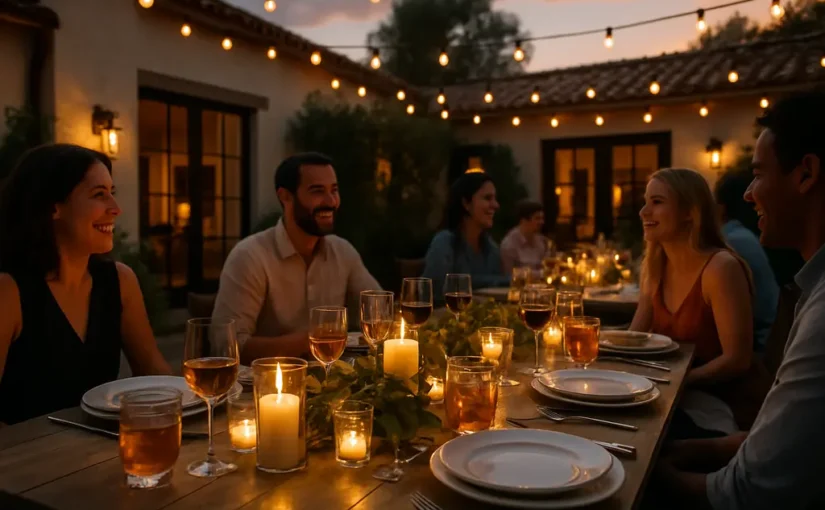
Durable outdoor lighting has become less a decorative afterthought and more a practical part of villa life, rather like a sensible cloak at a late supper: one hopes it looks agreeable, but it must first keep out the weather. The current interest is not difficult to understand. Homeowners wish to use terraces, dining courts, poolsides, and paths after daylight fades, yet the exterior is a demanding place for any fitting that must face rain, salt air, heat, insects, impact, and cleaning.
For a villa, the better question is not whether the garden should be lit like a stage. It should not. The question is which zones need safe, calm, and serviceable light, and which work ought to be left to a qualified electrician. A well-planned scheme may be modest in brightness and still generous in comfort. A badly planned scheme may glare across the table, fail early, or create hazards at the very places where guests are meant to move with ease.
Why Durable Outdoor Lighting Is Rising
Market Signals Without The Hype
The market evidence suggests that homeowners and designers are treating exterior lighting as a serious long-term product category. The global weatherproof outdoor lighting market was estimated at about US$19.01 billion in 2025 and projected to reach about US$37.90 billion by 2033, with a reported compound annual growth rate near 9.0%, according to a Verified Market Research report. Such figures do not prove that every homeowner needs a large lighting scheme. They do suggest that demand is being shaped by a wish to extend outdoor use into evening hours.
Weatherproof products used for outdoor power and lighting applications form a related category. One forecast placed that market at about US$4.76 billion in 2025, with plastic enclosures holding 41.7% share because of cost advantages and corrosion resistance, according to a Dataintelo report. For homeowners, this is useful not as a shopping command, but as a reminder that the enclosure and housing are not minor details. The casing of a fitting often carries as much practical consequence as the lamp itself.
Durable Outdoor Lighting And The Villa Plan
Durable outdoor lighting should begin with a plan of use, not a catalogue of fixtures. A dining terrace asks for gentle light on faces and food. A step asks for reliable visibility. A planting bed may need only a restrained accent, if it needs light at all. A service path beside refuse bins requires plain safety rather than drama. The villa will look more composed if light follows human movement, just as good planting follows sun, soil, and wind.
Survey notes from 2026 reported that 66% of U.S. homeowners included outdoor lighting in outdoor living or renovation projects, slightly up from 65% in 2024. That rise is not enormous, which is worth saying plainly. It points to steady priority, not a craze. For comparable planning of furniture, shade, and use zones before choosing fixtures, this related piece on practical outdoor living spaces may help homeowners set the lighting question within the larger design.
Material Choices And Exposure Risk
Housings, Finishes, And Local Conditions
The most handsome lantern is a poor bargain if its finish blisters or its enclosure admits moisture. Current exterior lighting discussions often point to powder-coated aluminum, brass, stainless steel, and weather-rated resins as common choices. Each material behaves differently. Brass may suit certain exposures and age with a patina. Stainless steel can be appropriate in some settings, though grades and maintenance matter. Powder-coated aluminum can give a crisp architectural line, but coatings can be damaged by abrasion or poor installation. Resin may resist corrosion, yet it still deserves scrutiny for heat, ultraviolet exposure, and impact.
In coastal districts, corrosion should be treated as an active design condition, not an unfortunate surprise. Research notes for 2025–2030 highlighted demand for IP68-rated LED floodlights with corrosion-resistant housings, especially in coastal regions. The rating alone should not lull a homeowner into carelessness. The fitting, the cable entry, the mounting surface, drainage, maintenance access, and the installer’s workmanship all affect service life. A villa by salt air is rather like a family with a sharp-tongued aunt: every weakness will eventually be mentioned.
What To Ask Before Buying
Before purchasing durable outdoor lighting, ask where the fixture will sit, how wet it will become, whether sprinklers will strike it, whether children or pets may knock it, and how easily it can be cleaned. Ask whether the manufacturer provides outdoor use instructions, replacement parts, and clear warranty terms. A fixture meant for a covered porch may be unsuitable for an exposed wall. A decorative floor lamp may be delightful beneath shelter yet foolish beside a pool edge unless the product is specifically rated for that exposure.
- For sheltered seating: consider warm, low-output fittings that reduce glare and allow conversation.
- For steps and paths: prioritize visibility, shielding, and predictable placement over ornament.
- For coastal or wet sites: ask about corrosion resistance, ingress rating, and maintenance requirements.
- For new wiring: use a qualified electrician and confirm permit or code expectations locally.
Layered Lighting For Villa Evenings
Ambient, Task, Accent, And Decorative Roles
The preferred design approach has moved away from a single bright source doing all the work. Layered systems combine ambient, task, accent, and decorative lighting to support dining, lounging, pathways, and movement once daylight fades. This is not merely prettier; it is often more comfortable. One glaring wall light may make a terrace feel exposed, while several low-output, shielded sources can define a dining area without announcing dinner to the whole neighbourhood.
Ambient light is the general softness that lets the eye settle. Task light belongs where hands work: serving, cooking, reading a menu, or finding a key. Accent light is best used sparingly, perhaps to catch a textured wall or specimen tree. Decorative light has its place, yet it should not be allowed to tyrannise the scheme. A villa exterior can have manners. It need not shout.
Colour Temperature And Dark-Sky Courtesy
Warm colour temperature lighting, roughly 2,400 to 4,000 Kelvin, is often discussed for exterior living areas, paired with controllable output and shielded, directional fixtures. The principle is sensible: light the surface needed, not the sky, not the neighbour’s bedroom, and not the eyes of guests at table. Some jurisdictions enforce dark-sky ordinances, so homeowners should check local rules before settling on fixture type, brightness, and placement.
Durable outdoor lighting is not only about surviving rain. A durable scheme is also one that remains pleasant to live with. If the lights are too cold, too bright, or too widely cast, the family may stop using them, which is its own form of failure. Test temporary positions in the evening with battery lanterns or clip-on mockups before committing to permanent work. This kind of planning is safe for most homeowners and can reveal glare problems early, without pretending that electrical installation is a casual weekend amusement.
Controls, Glare, And Safe Work Boundaries
Timers, Dimmers, Sensors, And Restraint
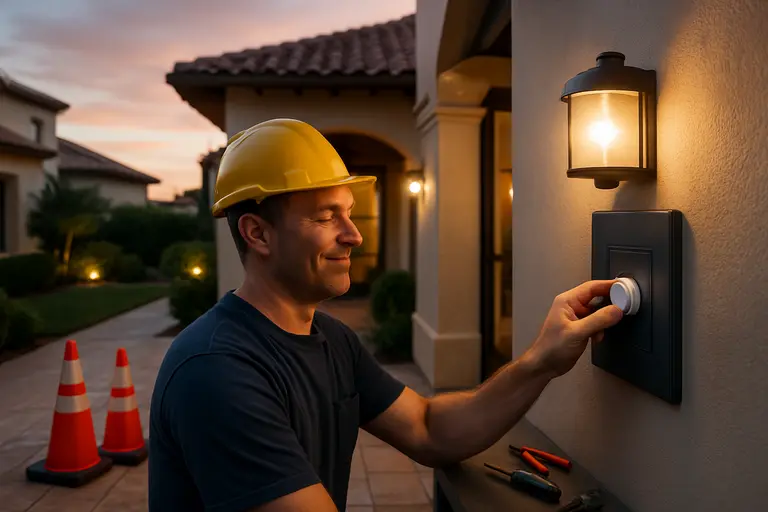
Controls such as timers, dimmers, motion sensors, and app-based operating systems are being used so exterior lighting can change through the evening. This is a practical development, provided it is not used to justify excess. A dimmed dining circuit, a motion-triggered side path, and a timed entry light may serve the household better than every fixture blazing from dusk to midnight. Lower output can reduce glare and energy use, though actual savings depend on the products, settings, and habits involved.
Motion sensors require judgment. If they aim toward a busy street or swaying planting, nuisance activation may irritate everyone. If they leave a stair in darkness until a person is already upon it, they may be poorly placed for safety. Dimmers should be compatible with the lamps and drivers specified. App controls may be convenient, but a manual switch remains a comfort when phones are misplaced, guests are present, or software sulks.
DIY Planning Versus Professional Installation
Homeowners can safely do much of the early work: list the evening activities, mark paths and steps, photograph dark corners, compare manufacturer literature, clean accessible fixtures after turning power off at the appropriate switch, and keep plant growth from blocking light. Those tasks are useful and dignified; no one need risk a shock to prove devotion to the house.
New circuits, exterior receptacles, hardwired fixtures, transformers, trenching near utilities, pool-adjacent lighting, and work on ladders or roofs should be handled by qualified professionals. Local codes, wet-location requirements, burial depths, and protective devices are not decorative opinions. They are safety matters. For additional insights on integrating lighting into property improvement, owners might consult Jimmy Guthrie Real Estate LLC, though design and electrical decisions should still be based on site conditions and licensed advice.
Durable Outdoor Lighting For Evenings That Behave
Durable outdoor lighting works best when it is planned as a quiet servant of villa life. It should help a person see the step, enjoy supper, cross the court, and return indoors without spectacle. The evidence supports rising demand for weatherproof fixtures and outdoor living after dark, yet demand alone is not design wisdom. The wiser course is to specify only what the site needs, choose housings suited to exposure, keep brightness modest, and reserve electrical work for those trained to do it safely.
The most agreeable evening setting is seldom the brightest one. It is the one in which the path is legible, the table is flattering, the planting is not abused by glare, and the house appears composed rather than restless. Treat the fixture, enclosure, control, and installer as a single decision. Then durable outdoor lighting may extend the villa’s hours with good sense, which is always more becoming than excess.