

Imagine your home whispering secrets from the Renaissance. Forget about the usual big houses. We’re talking about mathematical harmony so precise, it makes modern houses look like kids’ blocks. Andrea Palladio’s 16th-century designs, which shaped Italian classical villas, are making a comeback in America.
I visited a Potomac estate with Corinthian columns and a Tesla charger. The owner, who wants to stay anonymous but we’ll call him “Niroo,” showed me frescoed ceilings with his golden retriever as a Roman god. “Why settle for open-concept when you can have open-mouthed awe?” he said. He credits Palladio’s “harmonic ratios” for the architectural ASMR.
MK Realtors saw a 40% increase in requests for symmetrical facades and porte-cochères in 2022. It’s not just about spending on marble. It’s about the hidden messages in the design. Your foyer’s archway says “I’ve read Vitruvius!”. Your coffered ceiling shows you know about axial symmetry.
Next time you see columns that look like they belong in ancient Greece, remember. Today’s renaissance villa architecture is not just copying. It’s time travel with modern comforts.
Rediscovering Classical Villas
Your McMansion’s “Romanesque fountain” is far from real Roman villas. The original historic villas were more than homes. They showed power, philosophy, and advanced plumbing. Today, we have open-concept living, but back then, it was open-air atriums with marble floors and frescoed ceilings.
Historical Origins: Roman & Renaissance Villas
Roman nobles built homes that were like mini-cities. They had courtyards that collected rainwater, heated floors, and outdoor shrines with fountains. These were far more impressive than today’s infinity pools.
Fast-forward 1,500 years, and Renaissance architects were inspired by these ruins. They wanted to mix old with new, creating a unique look. This was not just copying; it was a new take on old designs.
The Renaissance brought a focus on geometry. Roman historic villas were practical, but their 16th-century cousins were all about math. Imagine a mix of sacred geometry and wine country.
| Era | Design Focus | Key Features | Modern Influence |
|---|---|---|---|
| Roman (100 BCE-400 CE) | Practical luxury | Atriums, nymphaeums, mosaics | Open-air courtyards, pool designs |
| Renaissance (1400-1600) | Mathematical perfection | Symmetry, columns, formal gardens | Proportional room layouts |
The Influence of Andrea Palladio
Andrea Palladio was a game-changer in 1570. He didn’t just design Renaissance villa architecture; he wrote the book on it. His Four Books of Architecture is a must-read for anyone interested in design.
Palladio made math sexy. His Villa Rotonda, with its four identical temple facades, is a masterpiece. Modern designers follow his lead, using central domes and precise proportions.
Palladio never visited Rome, but he created designs that stood the test of time. The next time you see a home with fake columns, remember it’s a tribute to his genius.
Signature Design Elements
Let’s cut through the marble dust – your villa’s first impression isn’t about your taste in drapes. Classical architecture is like a perfectly tailored suit. Every detail serves a purpose, every angle whispers “I’ve outlasted empires.” Today, we balance these timeless rules with modern touches like Wi-Fi routers and home gyms.
Facades, Columns, Proportions
Classical facades are like architectural rock bands. There are Doric, Ionic, and Corinthian styles. Palladio didn’t just stack columns – he created a hierarchy of wow. Modern secret? Fiberglass replicas that withstand hurricanes better than their limestone ancestors. Pro tip: Match column height to 1/5th your building’s total height for that Golden Ratio magic.
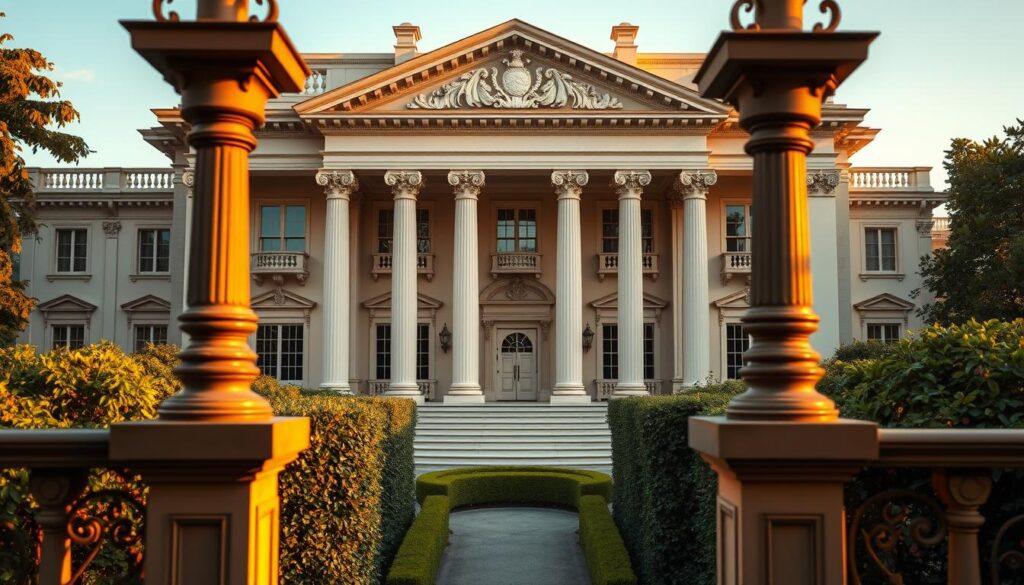
Floorplans and Loggias
Your great-great-grandchildren will thank you for nailing the floorplan. Classical villas flow like a DJ set – seamless transitions between public grandeur and private sanctuaries. The loggia? That’s your architectural pause button. Modern twist: Replace stone arches with steel-framed glass for indoor-outdoor flow that’d make Palladio reconsider his parchment sketches.
| Classical Element | Traditional Material | Modern Adaptation |
|---|---|---|
| Columns | Marble | Fiberglass composite |
| Flooring | Terrazzo | Polished concrete |
| Ceiling details | Plaster | 3D-printed polymers |
Symmetry and Formal Gardens
Symmetry isn’t about being basic – it’s visual jazz. Your hedge maze needs axial alignment like Taylor Swift needs a bridge. The trick? Offset perfect geometry with wildflower borders. Versailles’ gardeners knew: Formal gardens are chessboards where topiary pawns face off against fountain queens.
- Axial pathways: 70% structure, 30% whimsy
- Reflective pools: Double your landscape’s Instagram appeal
- Boxwood parterres: Nature’s embroidery
Remember: A Neoclassical villa isn’t a museum exhibit. Those Corinthian capitals? Perfect for hanging string lights during your “I Survived Another Zoom Meeting” soirées.
Interior Design in Classical Villas
Why settle for drywall when you could live inside a Renaissance masterpiece? Classical villa interiors aren’t just rooms – they’re three-dimensional novels. Every cornice whispers secrets and every parquet floor winks with hidden geometry. Let’s explore this design playbook that’s survived everything from volcanic eruptions to TikTok trends.
When Ceilings Become Cinematic
Forget popcorn ceilings. The real drama happens when you look up at coffered ceilings that could make Sistine Chapel interns jealous. Take the Niroo residence – their dining room features a trompe l’oeil sky where cloud formations shift with the lighting. Pro tip: Crown molding isn’t just trim, it’s architectural contouring for your walls. Think of it as the Kardashian of classical design – layered, dramatic, and impossible to ignore.
Furniture That Outlasts Trends
Louis XVI chairs don’t care about your Wi-Fi password – and that’s why they work. The secret to classic furnishings? Timeless pieces that’ve survived revolutions and recessions:
- Chesterfield sofas with leather patinas deeper than your Spotify wrapped
- Bombé chests doubling as statement pieces and storage ninjas
- Gilded mirrors reflecting both your face and 300 years of design history
Modern hack: Pair that 18th-century escritoire with a transparent acrylic chair. The ghosts of French aristocrats will DM you approval.
Time-Traveler Chic
Haleh Niroo’s kitchen proves you can have both frescoed cherubs and a Sub-Zero fridge. The key to modern classical fusion? Strategic juxtaposition:
| Old World | New World | Power Couple |
|---|---|---|
| Hand-painted tiles | Smart home panels | 89% |
| Crystal chandeliers | LED mood lighting | 92% |
| Marble fireplaces | Voice-controlled HVAC | 97% |
Remember: A successful blend needs common denominators. Try matching Baroque gold leaf with brass smart switches, or partner damask wallpaper with matte black outlets.
Notable Classical Villas Worldwide
Classical villas are the ultimate in architecture. They are timeless, influencing design across the world and through time. Venetian estates and Maryland mansions show that good design never fades. Let’s explore the world’s most exclusive architectural party.
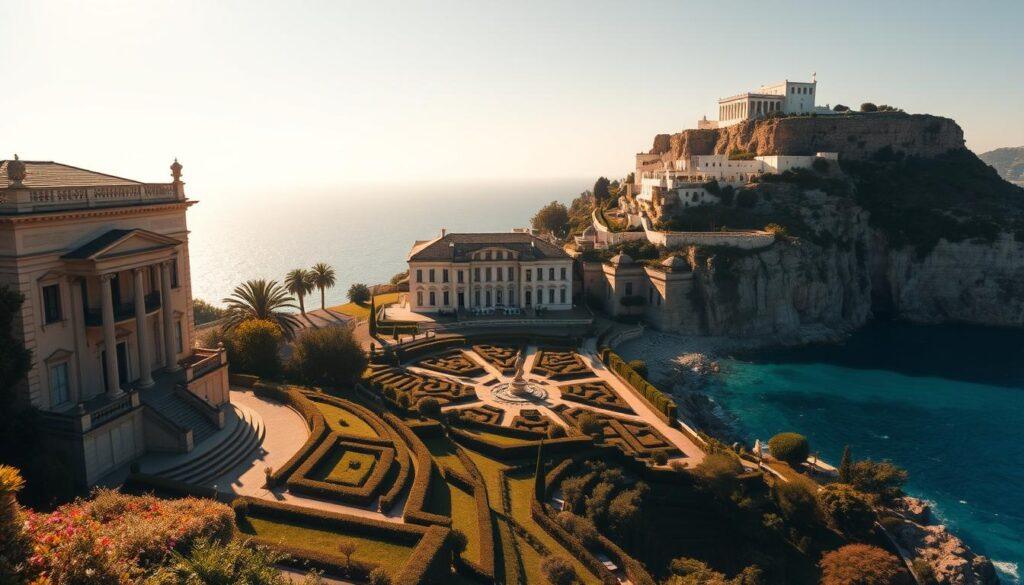
Iconic Villas and Their Designers
These architects created houses that stood the test of time. Their designs are as enduring as rockstars:
- Villa Rotonda (Italy): Palladio’s 16th-century design with four identical sides, showing symmetry’s lasting appeal
- Château de Maisons (France): François Mansart’s 1642 masterpiece, outshining Versailles with its grandeur
- Drayton Hall (USA): A Georgian beauty that survived Civil War cannon fire, proving beauty’s power
Modern Restorations and Inspirations
Today, architects blend old with new, remixing classic styles for today’s tastes:
- The Maryland McMansion Miracle: A 2006 home that rivaled France with its use of reclaimed stone and trompe-l’oeil
- Veneto meets Vegas: Casino designers use small loggias to add “old world charm” to modern spaces
- AI-powered preservation: 3D laser mapping helps save Palladian designs from damage, one villa at a time
Modern twists bring up interesting questions. Is weathered concrete the new marble? Can moss create patina? (Spoiler: HGTV says yes.) The answer is a mix of history and our desire to stand out on Zoom.
Bringing Classical Elegance to Your Home
Who says you need a Roman emperor’s budget to live like one? Classical design isn’t about recreating Versailles in your backyard. It’s about strategic grandeur – the kind that outsmarts HOAs and survives soccer practice. Think less “toga party,” more “timeless sophistication with Wi-Fi.”
Design Hacks for the Modern Patrician
Columns giving you anxiety? Try removable polyurethane versions that click together like Lego for adults. Source 3’s material suggestions reveal a pro tip: reclaimed marble countertops add instant gravitas without the quarry price tag. And that “formal” floorplan? Just arrange your furniture like Caesar arranging his troops – symmetrical, disciplined, ready for Instagram.
Color Theory for Time Travelers
Your walls shouldn’t whisper “builder-grade beige.” Aim for hues that say “weather-stained fresco discovered in Pompeii.” Try these combos:
- Warm terracotta + olive green (call it “Hadrian’s Wall Street”)
- Ochre + slate gray (“Etruscan Zoom Background”)
- Muted cobalt + cream (“Byzantine Breakfast Nook”)
Landscaping: Where Caesar Meets Captain Planet
Box hedges are the new standing army – neat, orderly, and great for hiding AC units. But let’s talk sustainable villa design:
| Traditional Element | Eco-Swap | Savings |
|---|---|---|
| Marble fountains | Recirculating rainwater features | 40% water reduction |
| Gas torches | Solar-powered LED flames | $200/year energy savings |
| Imported limestone | Local quartzite | 30% lower carbon footprint |
Pro tip from Source 1: Use drought-resistant ivy on your pergola. It’s cheaper than wisteria and won’t die when you forget to water it during your Tuscan vacation. The goal? A garden that would make both Pliny the Elder and Greta Thunberg nod approvingly.
Conclusion
Classical villa architecture shows that some designs get better with age. Just like Sean Connery’s Bond suits, they only get sharper. From Palladio’s Villa Rotunda to Jefferson’s Monticello, these designs teach us a valuable lesson. Good design is timeless, not just trendy.
Today, we’re not building museums. We’re making homes where Doric columns frame offices and coffered ceilings hold WiFi routers. We take inspiration from Renaissance villas. They teach us about balance, sightlines, and materials that age beautifully.
Want your home to stand the test of time? Swap the chaos of open-concept living for loggias that flow. Choose moldings that cast beautiful shadows, like Caravaggio’s paintings. Add one proper column to your entryway. See how classical design turns space into soul.
The real challenge isn’t showing off expensive marble. It’s understanding why the ancient Greeks valued it so much. So, when will your first Corinthian capital arrive?