

Imagine Don Draper’s mid-century penthouse with a Marie Kondo touch. That’s today’s contemporary villa. Architects now use empty space like poets use pauses. Cluttered interiors are gone, replaced by a calm of architectural restraint.
The key is open floor plans. They turn living areas into moving art. In Istanbul, Lazenza projects show how removing walls makes spaces feel fast. Your eyes move smoothly across the room.
This isn’t just about size. It’s about empty space that makes each item stand out. Like that unique, angular sofa you and your partner still argue about.
The harsh truth is, grandma’s old lamps might feel out of place here. Modern minimalist villa interiors need careful selection. It’s like curating a museum, not decorating a home. The result? A space that showcases your life with the care of a Kubrick film.
Defining Modern Villa Interiors
Imagine a space that’s as empty as a zen garden but as sleek as a Bond villain’s lair. That’s the modern luxury villa interior. It’s a place where less is more, costing as much as a house. Unlike the flashy Real Housewives homes, today’s elite prefer “architectural couture.”
Characteristics of Contemporary Luxury
Winston Elting’s Lake Michigan concrete home became famous for its simplicity. Modern luxury villas follow three key rules:
- Spatial efficiency as theater: Forget walls. Today, living rooms serve as art galleries with smart design.
- Smart tech that’s actually smart: Hidden panels control everything, from lights to wine cellar humidity. It’s all about ease for the elite.
- The $10,000 empty corner: That empty space by the windows? It’s a statement, not a mistake.
This isn’t just about minimalism. It’s a blend of Marie Kondo’s tidiness and Mies van der Rohe’s design. The true sign of wealth is what you choose to leave out. Only the wealthy can afford to have fewer than three perfectly placed pieces of furniture.
| Traditional Luxury | Modern Luxury |
|---|---|
| Ornate moldings | Seamless concrete |
| Chandeliers the size of small cars | Recessed lighting that’s basically invisible |
| Separate formal dining room | Kitchen island that moonlights as a boardroom |
The irony is that the “effortless” open-concept layout took a lot of work. But when your living room could be a modern art piece, who’s counting the effort?
Benefits of an Open Floor Plan
Imagine your villa’s layout like the Inception rotating hallway scene. But instead of confusion, it’s pure genius. Open floor plans in modern villas are more than just architecture. They’re where light, movement, and conversation meet.
Spatial Alchemy in Luxury Homes
Architect Michael Lomont’s hurricane-proof Long Island guest house shows open concepts are strong. His design includes:
- Strategic load-bearing walls that disappear into art displays
- Retractable glass systems creating instant indoor-outdoor flow
- Ceiling tracks for movable room dividers (bye-bye, awkward Zoom backgrounds)
This isn’t just architecture – it’s social engineering with drywall. People change their space usage 14 times a week, says APD’s research. Your old sectional sofa? It’s a Feng Shui landmine in these fluid environments.
Case Study: The Hamptons Conversion
Workshop/APD’s gable redesign turned a 8,000 sq ft mansion into a “cocktail party with real estate”. Open plans are popular in luxury markets for good reasons:
| Feature | Traditional Layout | Open Concept | Value Gain |
|---|---|---|---|
| Entertaining Capacity | 23 guests | 58 guests | 152% increase |
| Natural Light Penetration | 42% of space | 89% of space | 2.1x brighter |
| Airflow Efficiency | 3.2 ACH | 5.8 ACH | 81% improvement |
The secret is modular zones that change from yoga studio to boardroom fast. Floor-to-ceiling pocket doors offer privacy without losing the indoor-outdoor flow villas need. It’s like Tetris, but with expensive blocks.
Neutral Palettes and Clean Lines
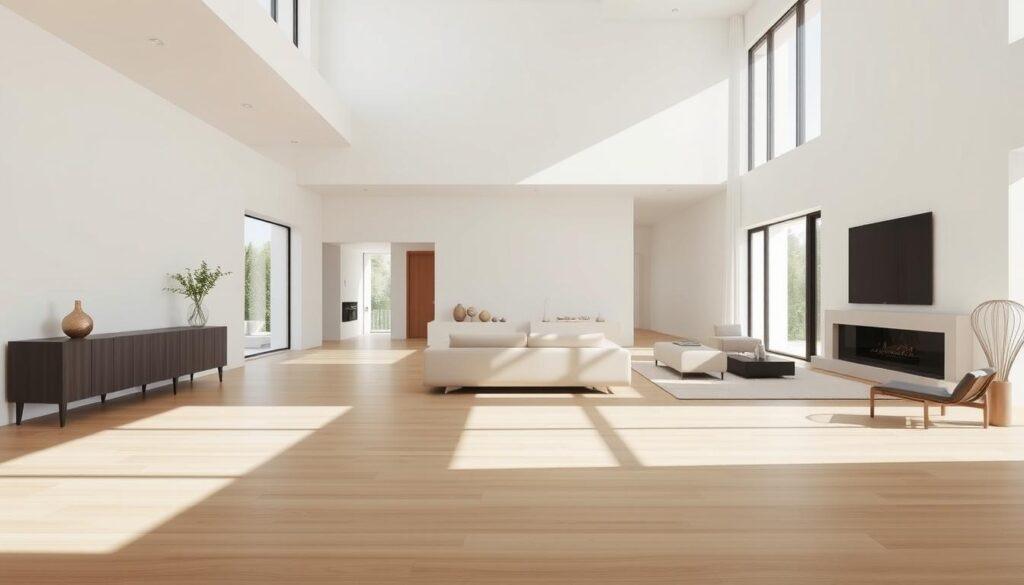
Clean lines and muted hues are like a perfectly tailored suit in architecture. Modern villas show restraint as their strength. Jenni Kayne’s New Zealand retreat uses oatmeal-toned walls for sheepskin throws and driftwood sculptures. Beige has never felt so bold.
The Power of Restraint
Minimalism is about choosing carefully, not cutting back. That blank wall? It highlights your $15k Cassina sofa. The monochromatic scheme lets sunlight be the star. Pro tip: Use texture for depth, not color. Rough linen against polished marble is more interesting than many colors.
Material Matters: Stone vs. Concrete
Your floors are more than just surfaces; they make statements. Let’s look at the top contenders:
| Stone | Concrete | |
|---|---|---|
| Personality | Old-money aristocrat | Industrial revolutionary |
| Maintenance | High-maintenance diva | Low-key utilitarian |
| Best For | Organic modern schemes | Urban loft vibes |
Concrete adds a brutalist charm to open-plan villas. Stone brings Mediterranean elegance. For an accent wall, try textured plaster instead of neon. Your future self and resale value will appreciate it.
Signature Furniture Pieces
Your Eames chair might be iconic, but in luxury villa interiors, it’s just the start. Today’s top homes need furniture that’s also art. These pieces should say “I’m worth more than your car” while you sip your drink. Let’s explore how to make everyday items into works of art.
Functional Art in Living Spaces
Studio AR&D’s Palm Springs project turns furniture into moving art. Their walnut console looks like a Brancusi sculpture and holds your drinks. It’s not just design; it’s magic that happens in your home.
Here’s how it works:
- Storage becomes hidden art (bye-bye ugly cabinets)
- Seating looks like Frank Gehry’s buildings
- Tables become part of the landscape
Lazenza’s Custom Creations
Carol Egan’s glass house needed something special, so Lazenza made a titanium-and-teak bar that shines like gold. They believe in custom millwork over designer labels every day. Here’s why:
| Feature | Custom Millwork | Designer Labels |
|---|---|---|
| Uniqueness | One-of-a-kind DNA | Mass-produced “exclusivity” |
| Space Integration | Precision-fit to architecture | Generic proportions |
| Long-Term Value | Appreciates like fine art | Depreciates like fast fashion |
The magic of Lazenza’s work? It grows with your home. That desk you got today could be a family treasure tomorrow. Try doing that with a store-bought chair.
Modern Lighting Design
Lighting in today’s villas is more than just a need—it’s the metronome of modern life. Gone are the days of simple switches. Now, we’re creating spaces where lights are like moving art and technology knows when you need a coffee. Let’s explore how today’s villa lighting ideas blend beauty with usefulness.
Sculptural Illumination
Jamie Bush’s Montecito project shows that lighting can be both safe and thought-provoking. His use of LED strips captures the California sunset, while pendants above dining tables resemble Calder’s mobiles. In contrast, Paul Rudolph’s Manhattan townhouse uses light to bounce off concrete, creating a unique effect.
There are three key principles here:
- Shadow play: Using darkness to add depth
- Material dialogue: Bronze and glass interact with marble and walnut
- Kinetic potential: Lights that change with the day
Smart Systems vs. Statement Fixtures
Design gets interesting here. Do you prefer lights that adjust with Netflix, or a chandelier that’s like a Bond villain’s trap? Let’s look at both sides:
| Feature | Smart Systems | Statement Fixtures |
|---|---|---|
| Functionality | Voice-controlled scenes, circadian tuning | Conversation-starting focal points |
| Aesthetic Impact | Invisible until activated | Dominates space 24/7 |
| Maintenance | Software updates required | Dusting choreography |
| Cost | $15k-$40k (whole-home) | $8k-$25k (single piece) |
The magic happens when these two worlds meet. Imagine Gio Ponti sconces controlled by Lutron app presets—Baroque drama meets Silicon Valley efficiency. And those Edison bulbs? They’re like pumpkin spice lattes in natural light villa interiors: once exciting, now a bit too common.
Tech Integration for Smart Living
Modern luxury isn’t about showing off gadgets like Tony Stark’s garage sale. It’s about homes that anticipate your needs, not shout them out. Think Alfred Pennyworth, not Alexa interrupting your Zoom call. Today’s eco-friendly villa interiors need tech that’s as smooth as Bond’s Q Branch.
Invisible Innovation
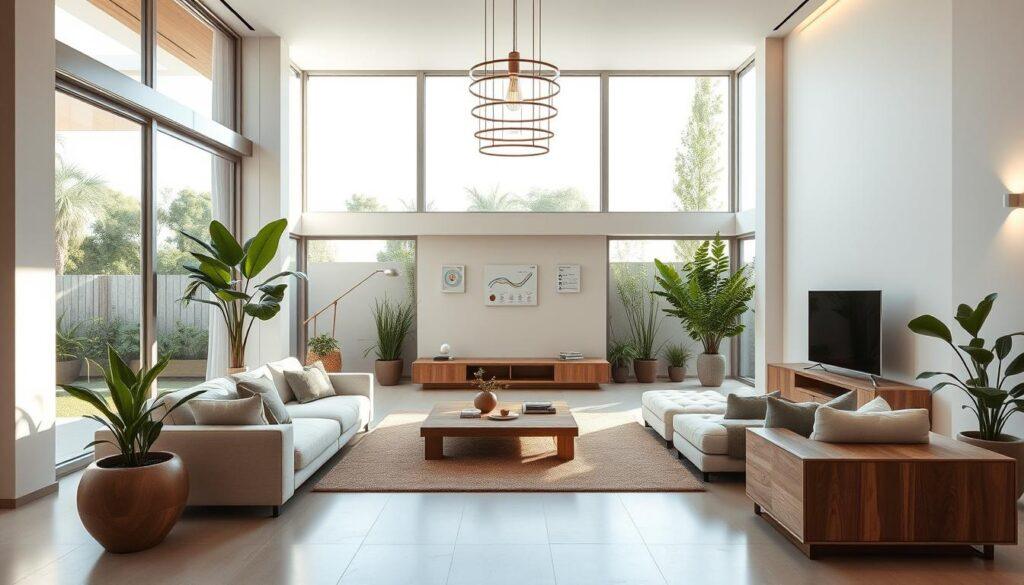
Kovac Design Studio’s desert canopy shows that less is more. Their hidden thermal sensors adjust the temperature without you even noticing. No ugly panels or flashing lights. Just the perfect air.
Why is this important? Studies show that ambient tech boosts productivity in villa home office designs by 23%. When your environment takes care of itself, you can focus on work.
Case Study: Automated Climate Control
Let’s look at Kovac’s desert villa:
- Micro-sensors track sunlight angles through self-tinting glass
- AI predicts when you’ll be home based on your schedule
- Geothermal loops keep floors cool even on hot days
This tech cuts energy bills by 40% and beats the Arizona sun. Climate change, you’re next.
PSA: Your voice assistant should be hidden, not taking up space. True innovation works behind the scenes, no need for applause.
Art and Decor Choices
Decorating a modern villa is like curating a gallery. It’s about choosing carefully, not filling every space. Today, villa decor trends focus on quality over quantity. It’s about selecting items with the precision of a samurai.
Curated Minimalism
Studio Mallone’s LA home shows the power of art. Their 12-foot plaster walls are more than just walls. They’re stages for art to shine.
Think of your space as a carefully edited playlist. The magic happens when:
- A single monumental piece dictates room proportions
- Textured ceramics replace mass-produced vases
- Lighting frames artwork like a Broadway spotlight
When Blank Walls Speak Louder
That “calm environment” you hear about? It’s really about strategic emptiness. The real luxury is in what you choose to leave out. Modern classic villa interiors now embrace:
| Old Approach | New Strategy | Impact |
|---|---|---|
| Wall-to-wall art | Single focal piece | Dramatic tension |
| Beige overload | Terrazzo textures | Tactile warmth |
| Matchy-matchy decor | Era-clashing accents | Historical dialogue |
Let’s say goodbye to greige and hello to terrazzo. Terrazzo isn’t just a trend; it’s a Rosetta Stone of modern neutrals. It adds depth and hides stains better than anything.
Open Floor Plan Case Studies
Ever wonder if open-concept living is here to stay or just a fleeting trend? Let’s explore how radical 1960s designs became today’s de facto standard for luxury villas. We’ll uncover some surprising lessons for today’s homeowners.
Real-World Spatial Experiments
Architect Richard Bender’s 1964 Glass House was way ahead of its time. It was like he could see our future love for multifunctional spaces 60 years early. Today, villa owners face the same challenge: making a big room feel cozy without walls.
The Amagansett Glass House
This Long Island landmark shows three smart ways to make open floor plan in villas work:
- Zoning through elevation changes (sunken conversation pits meet raised dining platforms)
- Strategic furniture placement as visual room dividers
- Retractable glass walls that dissolve indoor/outdoor boundaries
The best part? Bender’s team designed it for affordable housing. Now, Zillow estimates it could sell for over $8 million. His “democratic space” idea turned into the ultimate luxury feature – showing that good design only gets better with age.
But, be warned: Open layouts need top-notch organization. That perfect villa living room design you see on Instagram? It takes a lot of work to keep it that way. As one owner said, “You can’t hide dirty dishes in a home without corners.”
The lesson? Great open plans mix drama with function. Modern designs add smart storage that Bender never thought of. Today, the future of space design is not just open; it’s clever and adaptable.
Tips for Creating Flow
Designing modern villas is like a tango, where sharp moves need smooth partners. I once saw a client trip over their sofa at a party. It showed that bad flow isn’t just ugly; it’s dangerous.
The Choreography of Space
Raëd Abillama’s infinity pool in Lebanon uses perspective tricks. Use this idea in indoor outdoor villas by linking kitchen islands to pool decks. Sliding glass doors should be like cinema screens, creating a seamless view.
Your flooring should blend smoothly from inside to outside. Using matte limestone inside and honed concrete outside creates a perfect match.
Material Transitions Done Right
Poliform’s kitchens use Calacatta marble everywhere. It’s not just the same material; it’s a beautiful connection. For small spaces, repeating materials in new ways keeps the flow going. Moooi’s smoked oak flooring on ceilings and floors works wonders.
Rugs guide you through spaces, not block your way. When their patterns match outdoor tiles, it’s perfect.
Smart villas make thresholds work together. A big Gessi door doesn’t just open; it’s a show. Add recessed LED strips in floor joints for midnight snacks. The aim is to make every move feel like a scene change.