
In today’s world of sleek glass boxes, the Mediterranean style home stands out. It feels like a refreshing throwback.

This style evokes images of sunny cliffs and leisurely lunches, not just emails. It’s more than a look; it’s a way of life. It’s rooted in history and the joy of living.
The essence of Mediterranean design is simple: blending indoors with outdoors. Imagine spaces that feel airy and open, flowing into courtyards. It uses natural materials like stone and wood, and vibrant colors and tiles that tell stories.
Its origins go back to ancient Roman courtyards and Spanish haciendas. So, why do modern Americans love it? Is it the dream of a permanent vacation? Or is there something more profound behind its popularity?
We’re about to explore why this design is more than a fleeting trend. It’s a call for living at a slower pace, and doing it with elegance. This idea is as bold today as it was centuries ago.
Key architectural elements: arched doorways, red tile roofs, and natural materials
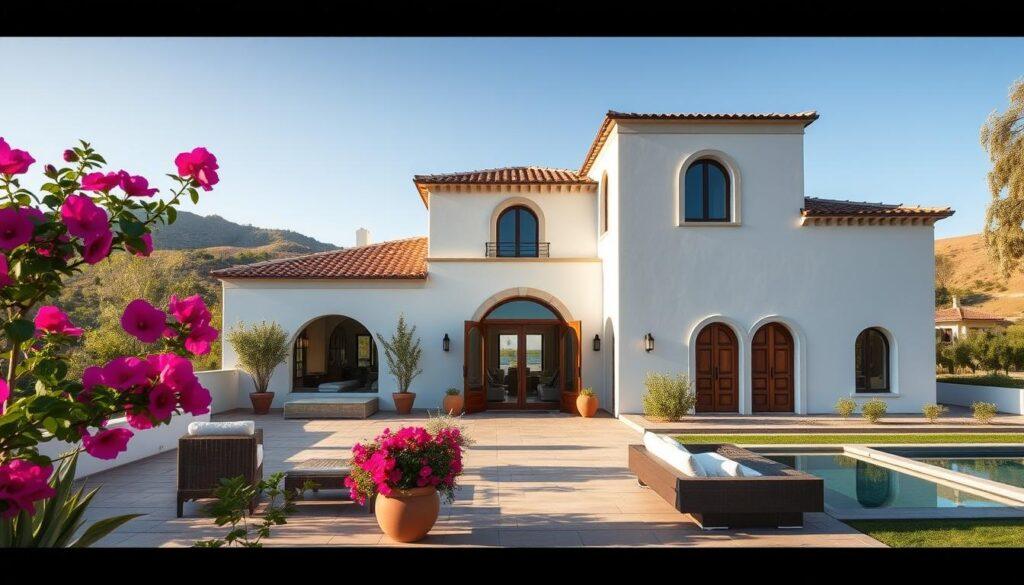
If modern design feels cold and boxy, Mediterranean villa design is its warm, sunny opposite. It’s all about the arch, the earthy roof, and using real materials. This isn’t just villa architecture; it’s a choice against the dull.
The arched doorway or window is the style’s most famous feature. It’s not just a hole in the wall. It’s a beautiful frame for your everyday life. This design echoes Roman aqueducts and Moorish mosques, adding beauty where straight lines rule.
The red tile roof is more than just for rain. It’s the villa’s crown, paying homage to the earth’s terracotta colors. This roof is real, not fake, like the earth itself. The colors come from places like Tuscany, Spain, and Greece.
Underneath, wooden beams show the building’s true bones. There’s no hiding here. The beams talk about strength, support, and real craftsmanship.
The wrought iron details add a touch of elegance. They’re like the black eyeliner of buildings. They make balconies, windows, and gates strong yet delicate. These wrought iron details contrast beautifully with the solid walls.
These elements—arched doors, earthy roofs, honest beams, and iron details—make a Mediterranean villa instantly recognizable. They are the essential features that define this style.
Interior design principles: warm color palettes, textured walls, and rustic finishes
The interior of a Mediterranean villa is warm, textured, and earthy. It’s where the design turns from grand to intimate. Unlike modern styles, it aims to engage all your senses.
Choosing colors is simple: take inspiration from the landscape. Use terracotta, ochre, and beiges that remind you of the sun. Add seafoam green, azure, and white for contrast. These colors bring the outdoors in.
Texture is key in this design. Stucco walls are the stars, with their unique, soulful surface. They catch light and create beautiful shadows.
Stucco walls are special because they feel alive. They have a natural, organic quality. Lime-washing them adds a soft, glowing finish.
Rustic finishes add to the charm. Look for distressed wood and hammered iron. Use natural fabrics like linens and wools for comfort and texture.
The result is a space that feels ancient yet welcoming. True Mediterranean villa design is about creating an experience. It’s about inviting touch, evoking memories, and celebrating time’s beauty.
Outdoor living spaces: courtyards, terraces, and garden integration
The Mediterranean design is all about blending indoors with outdoors. It’s not just a design choice. It’s a way of life.
Here, architecture fights against separating inside from outside. Big doors and shaded areas are more than features. They connect us.
The courtyard is the heart of the home. It’s not just a yard. It’s an outdoor room and the home’s center. It comes from the Roman *atrium*, a place for gathering.
Imagine a courtyard design with olive trees and lavender. Add a water feature for sound. This space invites you to linger.
The terrace is more than a place for furniture. It’s a primary living space for meals and chats. Your patio furniture is part of your home.
Gardens are not separate areas. They’re part of the home. Lavender touches your stairs, and bougainvillea frames your view. The garden is a part of your home.
This design philosophy changes what we think of luxury. Luxury is not just about fancy things. It’s about the experiences we have.
It’s about moving freely and enjoying shade. It’s about meals that move from kitchen to terrace. This design makes life more enjoyable.
This approach to Mediterranean villa design values outdoor living. It’s about creating a space for leisure, connection, and nature. Your home is your garden, and your life unfolds there.
Modern adaptations of traditional Mediterranean features
The secret to a Mediterranean villa design today is not copying old features. It’s about understanding their true meaning for today’s life. This isn’t just a renovation; it’s a new way to express the style’s essence. We’re keeping the style’s connection to nature and its warmth, but in a new way.
Let’s look at the arch, a key feature of the style. Today, we simplify it, removing the fancy details. What’s left is a clean, elegant curve. Imagine a tall, white archway next to a sleek, black door. It’s both old and new, showing smart editing.
Materials also get a modern twist. That old terracotta tile is now big and smooth. The look is familiar, but the size is new. Walls of rough stone become one big, smooth wall. We mix old textures with new marble for a fresh look.
Furniture gets even more interesting. Gone are the heavy, carved pieces. Now, we have furniture with smooth lines. A soft, linen sofa sits under a high ceiling. We add warmth with sheepskin rugs, mixing old and new.

To see how this works, let’s look at how old features evolve. The table below shows how we keep the style’s essence but make it modern.
| Traditional Feature | Modern Adaptation | Core Principle Preserved |
|---|---|---|
| Ornate, Small Arched Doorways | Oversized, Clean-Lined Archways (often with minimalist black frames) | Architectural Grace & Flow Between Spaces |
| Rustic, Red Terracotta Tile Roofs & Floors | Large-Format, Honed Terracotta or Porcelain Tiles in Neutral Earth Tones | Earth Connection & Thermal Mass Benefits |
| Heavily Textured, Color-Washed Plaster Walls | Smooth, Monolithic Plaster Finishes (Venetian or Tadelakt) in Warm Whites | Organic, Handcrafted Wall Feeling |
| Ornate, Curlicued Wrought Iron Details | Geometric, Linear Ironwork in Window Grilles, Railings, and Light Fixtures | Artisanal Metalwork as a Structural Art |
| Dark, Rough-Hewn Wood Beams | Lighter, Sleeker Reclaimed Wood Beams or Painted Beam Structures | Exposed Structural Elements & Natural Materiality |
This modern take shows the style’s flexibility. It’s not about copying old styles. It’s about creating a home that feels both old and new. For inspiration, check out how timeless style meets modern luxury. We aim to keep the style’s soul but update its look. The Mediterranean spirit fits perfectly in today’s homes.
Material selection guide: stone, tile, and ironwork options
Forget shopping lists. Choosing stone, tile, and ironwork for a Mediterranean villa design is like collecting pieces with a story. It’s not just a trip to the home center. It’s like an archaeological dig for authenticity.
Each material has its own story. Get it right, and your home feels centuries old. Get it wrong, and it’s just a theme park replica.
Let’s start with the bones: stone. Natural stone isn’t just a cladding. It’s the literal foundation of the style. We’re not talking about generic granite. We’re talking about stone with a biography.
Travertine is the elegant philosopher. Its porous surface and creamy veins whisper of Roman aqueducts and sun-baked piazzas. It’s perfect for floors that need to look like they’ve witnessed history.
Limestone is the rugged poet. More uniform than travertine, it offers a softer, matte finish. Think of the walls of a Greek island monastery. It says “strength” without shouting.
Then there’s tufa. This is the wildcard. A volcanic rock that’s lightweight and full of texture. It’s less common, which makes it the insider’s choice for a truly unique accent wall.
| Stone Type | Character | Best Use | Vibe |
|---|---|---|---|
| Travertine | Elegant, veined, porous | Floors, patios, wall cladding | Imperial Rome |
| Limestone | Rugged, uniform, matte | Exterior walls, fireplace surrounds | Aegean Monastery |
| Tufa | Textured, lightweight, volcanic | Feature walls, garden elements | Rustic Tuscan Farmhouse |
Now, for the pièce de résistance: the tile. If stone is the bones, tile is the skin. And here, we must bow to the undisputed king: terracotta tiles.
Terracotta is humble, earthy, and possesses a warmth that modern laminates can only impersonate. Its color is the very essence of a sunset over a clay field. It’s imperfect, it breathes, and it gets better with age. This is the soul of the floor.
But the royal family has other members. The Moroccan zellij mosaic is the mathematician. Intricate geometric patterns cut from glazed tiles form breathtaking, kaleidoscopic surfaces. It’s art for your courtyard fountain or kitchen backsplash.
Then, the Spanish azulejo. This is the storyteller. Hand-painted, often in cobalt blue and white, these tiles depict scenes from history, religion, or pure folklore. A wall of azulejos isn’t a wall; it’s a novel.
Choosing between them is a question of narrative. Do you want geometry or poetry? Earth or art?
Ironwork is the jewelry of your home. Is it the ornate, curlicued ballet of Spanish rejería? Think of window grilles so detailed they look like black lace.
Or is it the simpler, more geometric language of modern Greek design? Clean lines and right angles that frame a view without competing with it.
The ironwork decision is key. Ornate iron whispers “Old World grandeur.” Geometric iron says “modern Mediterranean clarity.” Both are authentic. Your choice depends on whether you’re channeling a Sevilla courtyard or a Mykonos veranda.
So, what’s the takeaway? Authentic Mediterranean villa design isn’t achieved by copying a look. It’s built by understanding the narrative of each material. Stone tells of the land. Tile tells of the culture. Iron tells of the craft.
Select travertine for its imperial history. Choose terracotta tiles for their earthy soul. Pick ironwork that matches your home’s personality. This guide isn’t about buying stuff. It’s about assembling a home with a legitimate passport stamped by the Mediterranean sun.
Case studies: Contemporary Mediterranean villa transformations
What happens when you turn a suburban box into a Mediterranean villa? Let’s look at real examples. Theory is nice, but seeing it in action is where design really shows its worth. I’ve dug through project files to find the best transformations.
These case studies are our test ground. They show that the Mediterranean spirit isn’t just in history books. It’s in the plaster, tile, and clever use of light.
Case Study 1: The Suburban Reinvention. The client had a typical American McMansion: beige, boxy, and lifeless. The challenge was huge. The designer’s clever move? They didn’t tear it down. They sculpted it.
They carved a central courtyard into the middle of the house, transforming the plan from introverted sprawl into a light-driven composition. This strategy aligns with biophilic design principles championed by International WELL Building Institute, which emphasize daylight access and indoor–outdoor connectivity as core drivers of occupant well-being. They also introduced arches and retained the red tile roof, blending vernacular Mediterranean cues with contemporary spatial planning.
The result was a lesson in holistic design. The courtyard wasn’t just a feature; it became the environmental engine and emotional core of the home. Circulation patterns reorganized around it, daylight penetration increased, and cross-ventilation improved. The indoor-outdoor flow felt natural because the architecture, not decoration, demanded it
Case Study 2: The Urban Apartment Alchemy. No arches, no terraces, no hope? Wrong. This modern high-rise had views of concrete, not the sea. The change was all about the inside, using color and texture.
The designer chose a sand and sea color scheme. Walls got a plaster finish that catches light in soft waves. The kitchen and bath tiles were handcrafted, adding a personal touch.
Furniture was low, linen, and natural. The goal was minimalism with warmth. Walking in, you felt the calm of a villa, even forty stories up. The essence was captured through feeling, not just structure.
So, what makes a transformation great? The table below breaks down the key strategies.
| Project Profile | Primary Challenge | Key Mediterranean Interventions | Outcome & Lesson |
|---|---|---|---|
| Suburban Estate (Texas) | Lack of character, poor natural light, disconnected rooms. | Creation of a central courtyard; addition of arched interior passages; preservation of original tile roof; use of local limestone. | Architectural surgery created flow and soul. The lesson: Edit boldly. A single strong gesture (the courtyard) can redefine an entire property. |
| City Apartment (New York) | Modern, cold finishes; no architectural heritage; limited space. | Full interior overhaul with textured plaster walls; a curated, warm-neutral palette; strategic placement of bespoke, artisan tiles and ironwork. | Atmosphere over architecture. The lesson: Texture is everything. Tactile surfaces and artisanal details can evoke a place memory stronger than any column. |
| Coastal Renovation (California) | Balancing modern open-plan living with traditional, compartmentalized Mediterranean style. | Use of large iron-framed glass doors to open to terraces; reclaimed wood beams on ceilings; zellige tile accents; holistic furniture plan with custom, weathered-oak pieces. | Heritage and modernity can fuse seamlessly. The lesson: Use contrast wisely. Modern glass connects you to the landscape, while aged beams root you in tradition. |
The common thread in every successful project? A holistic vision. It’s not just an arched doorway. It’s that doorway framing a view of a courtyard with a specific tree. It’s not just a tile. It’s that tile’s color echoing the plaster on the opposite wall.
Brands that specialize in bespoke furniture get this. They don’t just sell a table; they sell a piece of the narrative—a reclaimed olive wood slab that tells a story of sun and soil.
These case studies prove the principles we’ve talked about aren’t just theory. They’re a powerful tool. The real magic happens when you use them to tell your own story of home.
Budget considerations and phased implementation strategies
Let’s explore the dream of Mediterranean villa design versus the harsh reality of budgeting. The dream is of sun-baked stone and hand-forged iron. But, your wallet might have other plans. The key is a smart, step-by-step approach.
Begin with the easy wins. A splash of lime wash or a warm paint can change a room’s feel. Add textured linens and rustic ceramics next. This first step is affordable but sets the style’s foundation. It’s like learning the basics before diving into the story.
The next step is to make a bold statement. Replace a regular door with an archway. Add a simple wrought-iron light fixture. These moves are a mid-level investment that solidifies the style. Save the big-ticket items like terracotta flooring for last. This way, you focus on quality over quantity.
Real Mediterranean villa design took centuries to develop. Your home can follow a similar, thoughtful path. Build your dream home slowly, with care. Let your budget guide you towards a more authentic and lasting design.