

Outdoor Kitchen ROI deserves a cool head, not a feverish admiration for grills, stone counters, and moonlit suppers. A villa may wear an outdoor kitchen as charmingly as a muslin gown at a summer assembly, yet the expense must answer to climate, workmanship, daily use, and resale expectations. The market is certainly active, but a homeowner ought to separate broad demand from the narrower question: will this particular project repay enough of its cost, and will it serve the household safely?
The better decision begins with proportion. A modest cooking station placed near existing patio circulation may be easier to justify than a fully plumbed pavilion with every appliance one has admired in a showroom. Neither is wrong by nature. Each must be judged by site conditions, budget, and the skills required to install it without creating hazards.
Market Signals Without Overstatement
Demand Is Real, But Not A Promise
The outdoor kitchen sector has expanded into a sizeable category. The global outdoor kitchen market was valued at roughly USD 27.2 to 27.3 billion in 2025, with forecasts placing it near USD 29.7 billion in 2026 and between USD 52.7 billion and USD 60.2 billion by 2033 to 2034, according to a global market forecast. That is useful context, especially for villa owners weighing whether outdoor cooking is a passing fancy or a durable preference.
In the United States, the market generated about USD 9.7 billion in revenue in 2025 and is expected to reach about USD 18.2 billion by 2033, with a reported 8.2 percent compound annual growth rate through that period, according to the U.S. market outlook. These figures support the idea that buyers and homeowners continue to value outdoor living features. They do not, however, prove that every installation is a wise investment.
Why Market Growth Does Not Equal Household Payback
A national market can rise while an individual project disappoints. A villa in a warm region with frequent outdoor dining may make better use of a permanent cooking zone than a similar project in a colder climate with a short fair-weather season. Research notes for 2026 place typical U.S. outdoor kitchen installation costs between about USD 6,300 and USD 27,100, with an average near USD 16,500. That range is wide enough to swallow many assumptions.
Reported resale recovery also varies. Research notes describe typical national recovery around 50 to 65 percent, with warmer Sun Belt-type markets sometimes performing better when design and climate fit are strong. Colder regions may fare worse, especially where weather protection and durable finishes are lacking. A prudent owner treats these figures as planning context, not as a promise.
Outdoor Kitchen ROI Starts With Scope
Outdoor Kitchen ROI And Cost Discipline
Outdoor Kitchen ROI is often won or lost before the first cabinet is ordered. Scope is the polite word for appetite. A grill, counter, storage, and task lighting may support most family meals. A sink, refrigeration, gas lines, a roof structure, specialty appliances, and decorative masonry can lift the cost quickly, and each feature brings maintenance duties.
For a villa, the most persuasive design usually respects the house rather than competing with it. If the exterior is pale stucco and limestone, a heavy dark island may look like an uninvited relation at dinner. If the villa has timber soffits and warm paving, a restrained counter and weather-rated cabinetry may feel more natural. The question is not whether the kitchen dazzles on installation day. The question is whether it remains useful, safe, and visually compatible after several seasons of sun, rain, grease, and family use.
Match The Project To The Buyer And The Climate
Outdoor Kitchen ROI also rests on climate fit. In warm areas, frequent use can strengthen both enjoyment value and buyer appeal. In colder areas, homeowners may need shelter, wind control, freeze-resistant planning, and finishes that tolerate repeated wet-dry cycles. Those features can make the kitchen more practical, but they may also increase cost.
For a closer villa-focused discussion of cost recovery and project size, see this related article on 2026 villa ROI planning. Treat any payback estimate as a range. Condition, workmanship, and local buyer expectations can change the result more than a single national figure suggests.
Cost Control And Design Fit
Spend Where It Affects Use
The swiftest return is not always found in the grandest scheme. A well-placed preparation counter, heat-safe landing area, durable flooring, and sensible shade may serve better than a crowded appliance wall. I often advise villa owners to begin by drawing the meal: where food comes from, where it is set down, where the cook stands, where guests gather, and where smoke will travel. A charming kitchen that sends smoke toward the sitting area is not charming for long.
Before approving a design, compare the project against daily habits. If outdoor cooking happens twice a month, a compact plan may be more rational. If the household entertains often, durable counters and storage may matter more than decorative extras. Cost control is not meanness. It is the manners of a project behaving properly in its budget.
Materials Should Age Respectably
Villa exteriors benefit from materials that speak to the home’s architecture. Stone, masonry veneer, stucco, stainless components, and outdoor-rated cabinetry can each be appropriate, but exposure should guide selection. Dark surfaces may become hot in strong sun. Porous materials can stain near cooking zones. Unprotected cabinets may suffer in rain and coastal air. The wise owner asks how the material will look after grease, pollen, moisture, and cleaning.
A small mockup or sample board viewed outdoors is more useful than a showroom glance. Place samples near existing walls, paving, and planting beds. Observe them in morning and late afternoon light. If a material requires sealing or special care, include that labor in the real cost of ownership.
Safe DIY Limits Versus Professional Work
Reasonable DIY Tasks
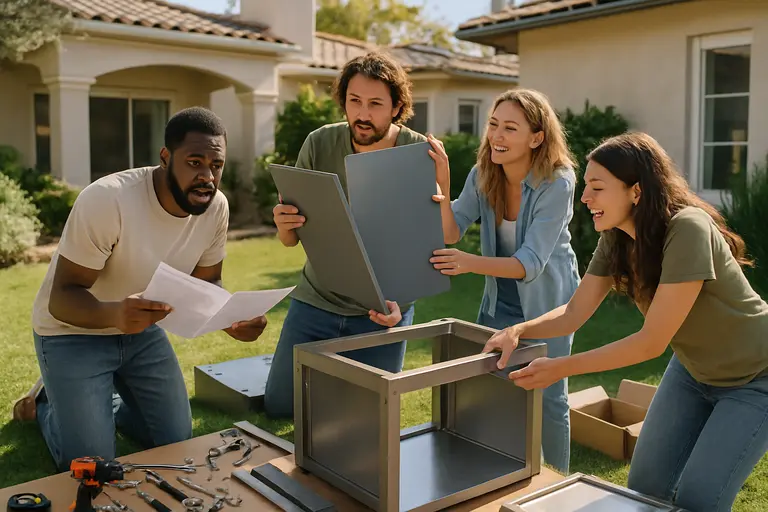
There are parts of an outdoor kitchen project that many careful homeowners can handle, provided they follow product instructions and local rules. Planning furniture clearances, comparing appliance dimensions, assembling freestanding storage, arranging planters, and selecting outdoor-rated furniture are lower-risk tasks. Painting nearby non-structural surfaces or refreshing simple decor may also be suitable for an experienced DIYer.
- Good DIY candidates: layout sketches, furniture placement, shade umbrella selection, decor, and routine cleaning.
- Use caution: heavy materials, masonry work, countertop handling, and work near door thresholds.
- Hire qualified pros: gas, electrical, plumbing, structural covers, drainage changes, and built-in appliance installation.
Work That Calls For Licensed Help
Gas connections, electrical circuits, plumbing lines, and roofed structures should be handled by qualified professionals. Improper gas work can create fire or carbon monoxide hazards. Outdoor electrical work must address moisture, weather exposure, and code requirements. Plumbing can be affected by freezing, drainage, and local permitting rules. Structural covers, pergolas attached to the house, and heavy stone counters can also create safety concerns if poorly designed.
Homeowners should check local permit requirements before committing to the project. A contractor should be able to explain what is being installed, which trades are involved, and how weather exposure will be addressed. For a broader home-building perspective from the same network, related home design resources from Jsie Mering Homes may help owners compare outdoor plans with the whole property.
Outdoor Kitchen ROI For Villa Owners
A Practical Decision Test
Outdoor Kitchen ROI is strongest when the kitchen suits the villa, the climate, and the household’s habits. Before signing, ask three plain questions. Will this be used often enough to justify its cost? Are the risky trades being handled by qualified professionals? Would a future buyer see the work as durable and natural to the property, rather than expensive clutter?
If the answer is uncertain, reduce the scope before increasing the budget. A gracious villa does not require a theatrical outdoor kitchen. It requires a well-placed, safe, durable space that makes meals easier and evenings more pleasant. That is where payback, enjoyment, and good sense may meet without quarrelling over the bill.