
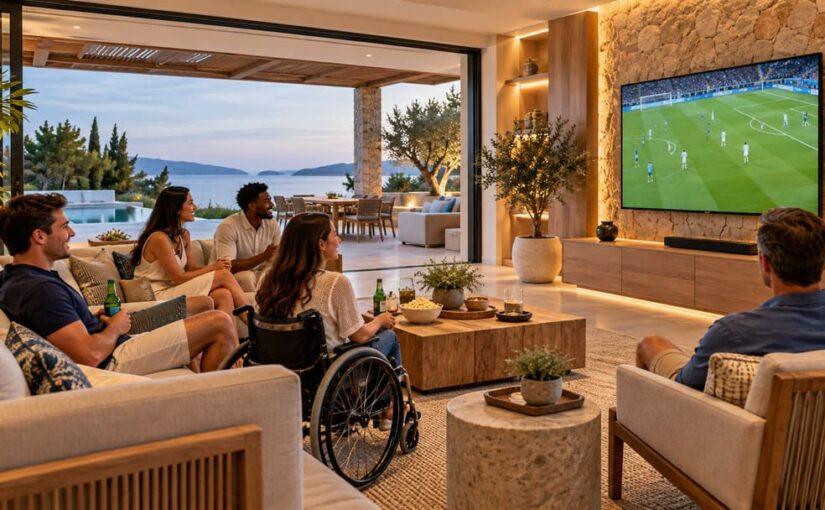
An accessible villa sports lounge should make watching a big game comfortable for everyone, not just the guests sitting directly in front of the television. Beautiful interiors can become difficult to navigate when furniture blocks walkways, deep sofas are hard to leave, or background noise overwhelms the commentary. A thoughtful design starts with clear routes, flexible seating, good visibility and entertainment controls that people can use without assistance.
Today’s sports gatherings also extend beyond the main screen. Guests may check scores, follow fantasy competitions or explore online betting services on their phones. For adults researching a particular operator, the question Is BetOnline safe? requires more than checking whether a website works: its offshore licensing and lack of U.S. state sportsbook regulation affect the consumer protections available. Those choices remain individual responsibilities, subject to local law, rather than something a host needs to build into the room.
For homeowners, the real design opportunity is creating a space where people can participate in different ways without being separated from the gathering. Weekender Villas already explores flexible furniture, screen placement and everyday usability in its guide to designing a villa game-day lounge. Accessibility adds another essential layer: planning for mobility, hearing, visibility and comfort before committing to permanent installations.
Accessible Villa Sports Lounge Design Starts With Movement
The first design decision should be the route guests take from the entrance to the seating area. That route should remain usable after people arrive, pull out chairs, move side tables and begin serving refreshments.
Large sectional sofas, oversized coffee tables and decorative furniture can reduce circulation space. An arrangement that looks generous in an empty room may feel crowded once several guests are seated.
The U.S. Access Board’s guidance on accessible routes specifies a minimum continuous clear width of 36 inches for accessible walking surfaces under the ADA Standards, with additional clearance requirements in certain situations. Although these standards do not automatically apply to an ordinary private home, they offer a useful reference when evaluating circulation.
Homeowners should consider the following design priorities:
- Maintain clear pathways: Keep the route between doors, seating, refreshments and bathrooms free of furniture and loose cables.
- Reduce unnecessary level changes: Avoid creating raised platforms or steps solely for a theater-like appearance.
- Leave room to turn: Consider the maneuvering space required by guests using wheelchairs or other mobility aids.
- Choose stable flooring: Rugs should not create curling edges, unstable surfaces or tripping hazards.
- Keep controls accessible: Light switches, remotes and other frequently used controls should be reachable from suitable positions.
Before purchasing furniture, mark its proposed footprint on the floor with removable tape. This simple exercise can reveal whether a sofa leaves enough space for someone to move comfortably behind it or approach an adjoining terrace.
For any substantial accessibility renovation, consult a qualified designer and the people who will use the space. A dimensional guideline cannot replace an assessment of individual needs.
Design Seating Around People, Not Just the Television
Traditional home theaters often prioritize identical recliners arranged in fixed rows. That approach can be effective for movies, but a villa sports lounge usually benefits from a more adaptable arrangement.
Consider combining a supportive sofa, individual armchairs and movable side tables. Chairs with firm cushions and useful armrests may make sitting down and standing up easier for some guests than very low, deep seating.
The arrangement should also accommodate someone who remains in a wheelchair without placing them at the edge of the gathering or blocking another guest’s view.
Keep the Screen Comfortable From Multiple Positions
A large television is not automatically easier to watch.
Screen height, seating distance, reflections and the angle between viewers and the display all affect comfort. A person watching from an upright chair may have a different sightline from someone sitting on a low sofa.
Rather than mounting the television according to its size alone, test the intended viewing positions before installation.
Sit in each proposed location and check whether viewers must tilt their heads significantly, whether other guests obstruct the image and whether on-screen text remains readable.
Large villa windows introduce another problem: changing daylight.
A television positioned opposite a bright terrace may suffer from reflections during afternoon games. Adjustable window treatments can help without permanently darkening the room or sacrificing architectural views.
For a flexible space, controllable natural light is generally more useful than designing every gathering around blackout conditions.
Make Sports Commentary Easier to Follow
Sports broadcasts combine commentary, crowd noise, music and sudden changes in volume. Those layers can make dialogue difficult to understand, especially in rooms with reflective stone, glass and polished flooring.
Turning the volume higher is not always the best solution.
The National Institute on Deafness and Other Communication Disorders explains that assistive listening devices can help people hear desired sounds more clearly, particularly in environments with background noise.
For villa owners, the practical starting point is a room that supports speech clarity.
Upholstered furniture, suitable rugs and curtains can help control the room’s reflective character. Speaker positioning and equipment settings also deserve attention, particularly when background effects seem louder than commentary.
Make Captions Part of the Setup
Closed captions should be easy to activate before guests arrive.
The Federal Communications Commission’s television captioning guidance explains how captions provide access to spoken dialogue and meaningful program sounds for viewers who are deaf or hard of hearing.
Homeowners should test captions on the actual television service or streaming device being used. Caption availability, appearance and settings may differ across equipment and services.
A practical pre-event test involves displaying a live sports broadcast, enabling captions and checking their readability from several seats. Make sure the text is visible without guests needing to change seats or ask repeatedly for adjustments.
Good accessibility also means avoiding assumptions. Some viewers prefer captions while others find them distracting. A host can ask guests about preferences and make reasonable adjustments rather than treating one setting as universally ideal.
Connect Refreshment Areas Without Creating Obstacles
An entertaining space needs food and drink access, but the serving arrangement should not interrupt the main circulation route.
A bar counter or snack station placed directly behind primary seating can create congestion. Guests repeatedly crossing in front of the television may also disturb people who rely on a clear sightline.
Where space permits, locate refreshments along a secondary wall or near the kitchen entrance. Keep serving items within comfortable reach and avoid forcing guests to carry drinks through narrow furniture gaps.
This becomes especially important when the sports lounge opens onto an outdoor terrace.
The principles behind comfortable outdoor spaces for villa living apply here as well: shade, stable surfaces, drainage, lighting and clear transitions determine how usable an outdoor gathering area becomes.
If the indoor room connects to a patio, inspect door thresholds and floor-level differences. Sliding doors and large openings can create appealing visual continuity, but an attractive transition is not necessarily a step-free or accessible one.
Any structural or permanent changes to thresholds, ramps or doors should be evaluated by appropriately qualified professionals.
Which Accessibility Improvements Should Come First?
Not every improvement requires construction.
For many existing villas, the biggest immediate gains come from rearranging furniture, improving controls and making the screen easier to see and hear.
| Design concern | Lower-disruption improvement | When professional help may be needed |
|---|---|---|
| Narrow circulation routes | Rearrange furniture and remove unnecessary tables | Doorway alterations or permanent layout changes |
| Poor screen visibility | Test seating positions and adjust window coverings | Relocating electrical connections or installing heavy displays |
| Difficult-to-hear commentary | Enable captions and review audio settings | Integrated assistive listening or custom acoustic systems |
| Uncomfortable seating | Add supportive armchairs and suitable side tables | Fixed seating platforms or architectural alterations |
| Inaccessible terrace connection | Keep existing routes clear and provide a comfortable indoor alternative | Threshold reconstruction, ramps or structural changes |
The order of improvements matters. Spending heavily on entertainment equipment before checking access can produce an impressive room that remains uncomfortable for certain guests.
A more disciplined approach separates changes that can be tested immediately from those requiring technical design, permits or licensed installation.
Test the Space Before Hosting a Crowd
A lounge that works for two people may behave differently with ten guests, serving trays and several conversations happening simultaneously.
Before a gathering, conduct a realistic trial.
Start at the entrance and walk toward the viewing area. Check the route with the furniture in its actual position, including chairs pulled out for use. Repeat the exercise from the refreshment area to the seating and bathroom.
Then watch part of a real broadcast from different seats. Turn captions on, adjust the sound and test the lighting as it would be used during the event.
Pay attention to small obstacles. Is a charging cable crossing a walkway? Does someone need to stretch across another guest to reach a side table? Can a person move from the sofa to the terrace without navigating around furniture?
These observations often reveal improvements that a polished architectural rendering cannot.
A useful final step is asking guests whether they have seating, mobility, sensory or communication preferences that the space should accommodate. The goal is not to make assumptions about anyone’s abilities. It is to make participation easier.
A Villa Lounge Should Adapt to the People Using It
The most successful sports-viewing spaces are not necessarily the largest or most technologically sophisticated.
They are rooms that allow guests to enjoy the same gathering in different ways: watching closely, following captions, discussing the match, stepping outside for quieter conversation or simply spending time together.
For villa owners planning a renovation, accessible circulation, clear sightlines and comfortable seating deserve attention before oversized screens, elaborate media walls and decorative upgrades.
That approach also makes the lounge more useful beyond sports. A room that accommodates different people and activities can serve family movie nights, everyday relaxation and social gatherings without requiring another major redesign.
The best next step is practical: measure the existing room, test the furniture layout and identify the barriers that can be removed before construction begins.